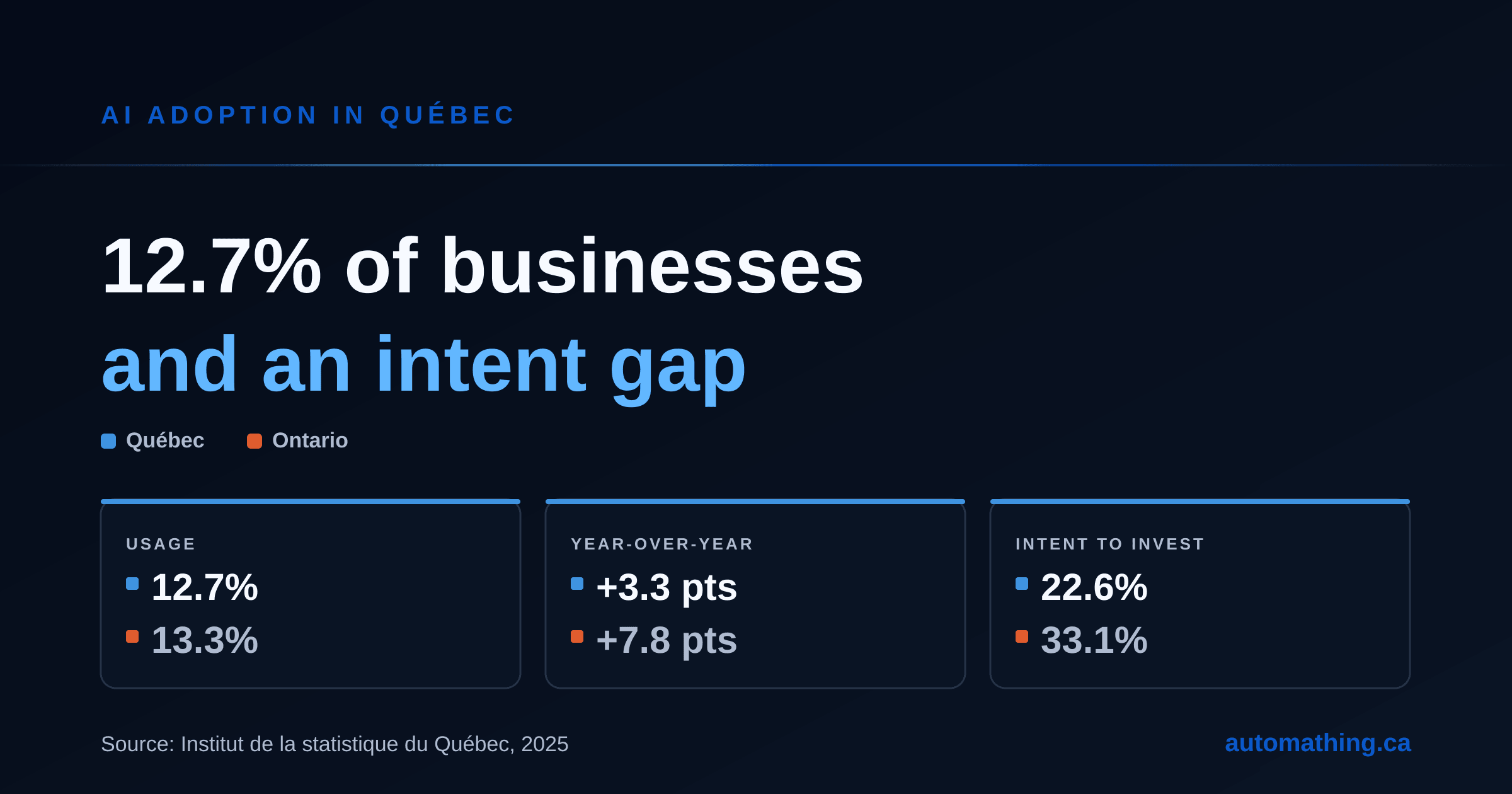


Artificial intelligence is everywhere in the headlines, but real adoption among Quebec SMEs stays low: 12.7% of businesses, per the latest ISQ data. Why? Because most AI content swings between magical promises and impenetrable jargon. Neither helps an SME owner decide what to actually do on Monday morning.
This article takes the opposite angle: concrete use cases by industry, what AI will not do for you, realistic ROI, and the tax credits that make AI projects far more affordable in Quebec in 2026.
The real question: "do I have a problem AI solves well?"
The most common mistake is starting from the technology ("we need AI") rather than the problem. AI isn't a goal; it's a tool that excels at a few specific things:
- Recognizing patterns in large quantities of data (fraud detection, demand forecasting)
- Understanding and generating language (summaries, email classification, customer-service replies)
- Extracting information from unstructured documents (invoices, contracts, forms)
- Recommending and prioritizing (which customer to follow up with, which part to order)
If your problem doesn't resemble any of those, AI probably isn't the answer, and classic software or standard automation will do it better, faster and cheaper.
AI in Business: 4 Questions to Ask Before Any AI Project
Before launching any AI project, answer these 4 strategic questions: inefficiencies, team alignment, target outcomes, and data governance.
Concrete use cases by industry
Manufacturing
- Predictive maintenance: anticipate equipment failures from sensor data.
- Visual quality control: detect defects on a production line through computer vision.
- Demand forecasting: adjust production and purchasing to real trends.
Retail and distribution
- Inventory optimization: reduce stockouts and overstock.
- Recommendations: suggest the right product to the right customer.
- Order extraction: automatically read PDF purchase orders.
Professional services
- Document sorting and summarizing: contracts, files, emails.
- Writing assistance: draft replies, proposals, meeting notes.
- Augmented customer service: an AI chatbot that handles frequent questions 24/7.
Finance and administration
- Anomaly detection in transactions.
- Automated reconciliation of invoices and payments.
- Categorization of expenses and ledger entries.
What AI won't do for you (let's be honest)
Tempering expectations is what prevents failed projects:
- It doesn't replace judgment. AI proposes; a human decides, especially in high-stakes cases.
- It isn't 100% reliable. It sometimes gets things wrong, confidently. Any serious deployment keeps human oversight on critical cases.
- It hates bad data. Garbage in, garbage out: without clean data, results are mediocre.
- It isn't instant or free. A good AI project takes scoping, data and iteration, like any quality software.
The realistic ROI of an SME AI project
The best SME AI projects aren't spectacular: they eliminate one specific bottleneck. A system that automatically reads and classifies 200 incoming emails a day, a model that prioritizes the follow-ups most likely to convert, a document-data extractor: these are measurable gains, not science fiction.
Apply the same rigour you'd use for any software investment: time saved, errors avoided, revenue unlocked, all amortized over three to four years. Our ROI calculation method applies directly.
Rule: an SME AI project should target a single, costly bottleneck. If you can't name the problem in one sentence, you're not ready.
Tax credits make AI affordable in Quebec
This is the Quebec advantage. Developing AI solutions is often eligible for major incentives:
- CRIC: the new credit for research, innovation and commercialization offers up to 30% refundable on the first million dollars of eligible spending, ideal for AI projects that involve R&D.
- Federal SR&ED: up to 35% refundable for a Canadian-controlled private corporation, stackable with the CRIC.
- CDAE/AI: the e-business development credit is being refocused precisely on AI-integrating solutions, with support reaching up to 30% per eligible employee.
The full breakdown of programs is in our 2026 tech tax-credits guide.
Data first: the prerequisite everyone skips
Before we talk about models, let's talk about data, because that's where 80% of SME AI projects succeed or fail. An AI model is only as good as the data you feed it. Ask three questions before any project:
Is it digital? If the information lives in binders, employees' heads or scattered PDFs, the first step isn't AI; it's digitization and organization. A clean systems integration is often worth more in the short term than a sophisticated model.
Is it clean and consistent? Fields filled in haphazardly, duplicates, inconsistent formats: AI will amplify the mess. Upstream cleanup is almost always necessary.
Do you have enough of it? Some techniques (forecasting, anomaly detection) require sufficient history. Others (document extraction, language) work with less. Scoping this avoids false promises.
The good news: preparing your data is never wasted. Even if the AI project waits, clean data improves your reports, your decisions and your classic automations.
AI in our own products
We don't just advise on AI; we ship it. TowerZ, our intelligent business platform, understands the business, clarifies priorities, and turns the right signals into action by connecting analysis, planning, and operations. Its AI works from real business context to surface priorities and prepare next actions for human approval. That's the kind of "useful and quiet" AI we recommend to SMEs: intelligence embedded in the work, not a gadget sitting beside it.
How to start without getting burned
- Identify a single bottleneck that's costly and repetitive.
- Check your data: is it digital, clean, accessible?
- Build a prototype at small scale before investing big (see our MVP guide).
- Keep the human in the loop on high-stakes decisions.
- Measure the before/after and iterate.
Why the "boring" AI projects win
There's a pattern worth naming: the AI projects that deliver real value for SMEs are almost never the ones that make for an exciting demo. The flashy use cases (a chatbot that writes poetry, a model that generates marketing images) rarely move the needle on a balance sheet. The ones that do are unglamorous: reading the same invoice format 300 times a day, flagging the three transactions out of ten thousand that look wrong, sorting a support inbox so the urgent tickets surface first. They work because the task is narrow, the data is consistent, and the cost of a small error is low. That's exactly the profile where today's AI is reliable.
So when you evaluate an AI opportunity, be suspicious of anything that sounds impressive in a meeting but hard to measure afterward. The right question is never "is this cutting-edge?" but "would I notice, in dollars or hours, if it stopped working tomorrow?" If the answer is a clear yes, you've found a project worth funding. If it's a vague "it would be nice," you've found a distraction, and probably an expensive one.
Frequently asked questions
Is my business too small for AI?
No. The most profitable SME AI projects are targeted and modest: document extraction, email triage, forecasting. Size matters less than data quality and clarity of the problem.
How much does an AI project cost for a Quebec SME?
A targeted project often starts around $20,000–60,000, but tax credits (CRIC, SR&ED) can cut the net cost by 30 to 50%. A prototype can cost much less.
Is generative AI (like ChatGPT) enough?
For general tasks, sometimes. But to automate a business process with your own data, in compliance with Law 25, an integrated and supervised solution is usually necessary.
Go from curiosity to a project
AI is neither magic nor useless: it's a powerful tool for specific problems. The Quebec SMEs that succeed aren't the ones that "do AI," but the ones that solve a real bottleneck with it, often largely funded by tax credits.
Our artificial intelligence and machine learning services always start with this question: what problem, exactly? Book a free discovery call and we'll honestly assess whether AI is the right answer for you.