
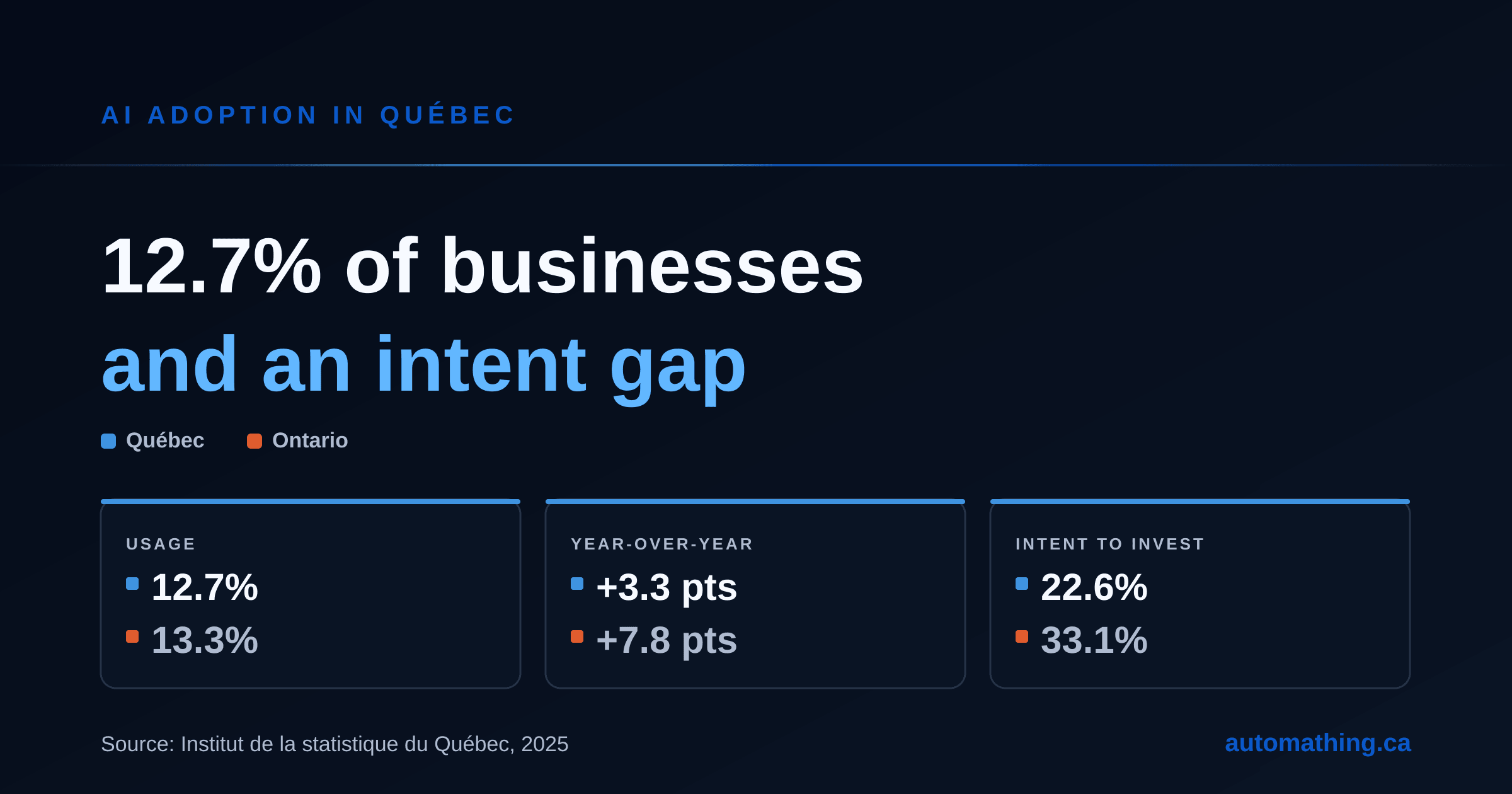
In November 2025, the Institut de la statistique du Québec (ISQ) published its analysis of artificial intelligence adoption and use by Québec businesses, drawn from four quarters of the Canadian Survey on Business Conditions. The number everyone will quote: 12.7% of Québec businesses used AI applications for production purposes in the 12 months preceding the second quarter of 2025.
That number will be read as evidence of a lag. It's a misreading. On level, Québec is in a statistical tie with Ontario (13.3%). The real signal sits elsewhere, and it's more concerning: it's in speed and in intent.
AI adoption in Québec: the key statistics
- 12.7% of Québec businesses used AI for production purposes in the 12 months before Q2 2025, up from 9.4% a year earlier
- Ontario sits at 13.3%, but grew +7.8 points in a year against Québec's +3.3 points
- 22.6% of Québec businesses consider investing in AI tools important, against 33.1% in Ontario
- 26.1% usage among businesses with 100+ employees, against 12.2% among the smallest SMEs (1 to 4 employees)
- 37.7% of AI users report a moderate-to-large reduction in previously manual tasks
- Main barriers: implementation cost (27.2%), ROI uncertainty (19.3%), lack of specialized knowledge (14.3%)
AI usage rate in Québec: 12.7% of businesses
12.7% against Ontario's 13.3% is a gap of six tenths of a point. That isn't a lag, it's noise.
Now look at the year-over-year progression. In Québec, the share moved from 9.4% to 12.7%, a gain of 3.3 percentage points. In Ontario, over the exact same period, the gain was 7.8 points: more than double.
And the forecasts widen the gap rather than closing it. Asked in the third quarter of 2025 about the coming 12 months, 13.1% of Québec businesses planned to use AI (up 1.5 points from the same question a year earlier), against 16.5% in Ontario (up 5.5 points).
Two provinces start from the same place; one accelerates, the other doesn't. A gap in level can be closed. A gap in the derivative widens on its own.
Québec vs Ontario: where the AI gap actually opens
This is where the ISQ data gets genuinely interesting, because it lets us rule out the lazy explanation: "Québec businesses are more cautious about technology."
They aren't.
| Indicator (Q2 2025) | Québec | Ontario |
|---|---|---|
| AI use, preceding 12 months | 12.7% | 13.3% |
| Moderate-to-major digital investment, past 3 years | 21.6% | 20.3% |
| Planned adoption: cloud computing | 17.0% | 17.1% |
| Planned adoption: security software tools | 15.1% | 17.0% |
| Planned adoption: AI software | 14.7% | 19.7% |
| AI investment rated "quite" or "very important" | 22.6% | 33.1% |
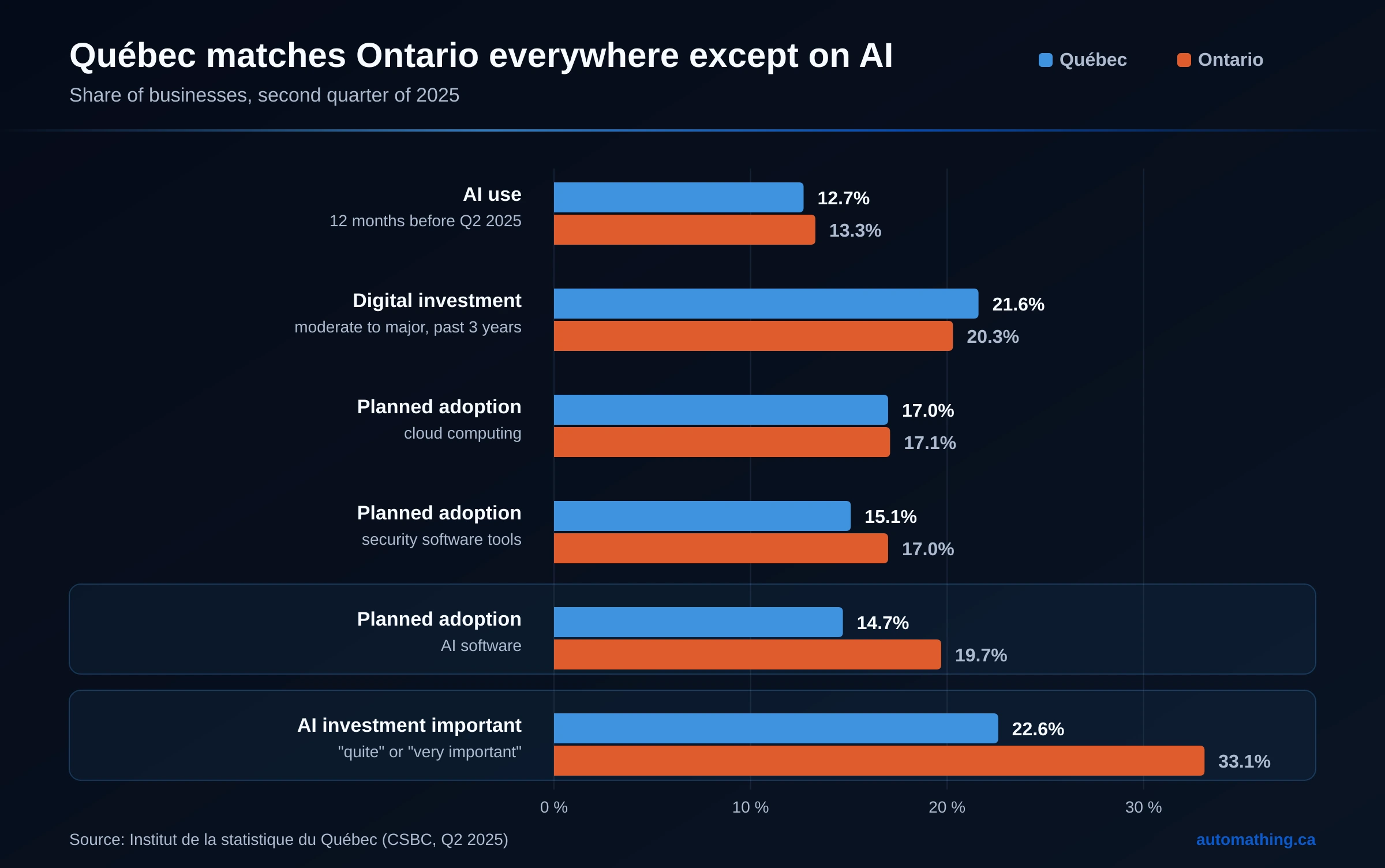
The first three rows tell one story: on past digital investment, Québec does as well as Ontario (21.6% against 20.3%, a difference the ISQ itself calls "similar"), and on cloud computing the two provinces are indistinguishable (17.0% against 17.1%).
The last two rows tell another. On AI, and on essentially AI alone, the gap opens, and it opens wide: five points on planned adoption, ten and a half points on how important AI investment is considered.
So this isn't general technological caution. Québec businesses invest, migrate to the cloud, secure their systems. They do everything Ontario does, except treat AI as a priority investment. The deficit is specific, and it's mental before it's budgetary.
Which is also why it needs to be taken seriously now: intent precedes use. The intent gap measured in 2025 is the adoption gap we'll measure in 2026 and 2027.
Types of AI used by Québec businesses
The second finding matters just as much: the Québec businesses that do use AI nearly all use it for the same thing.
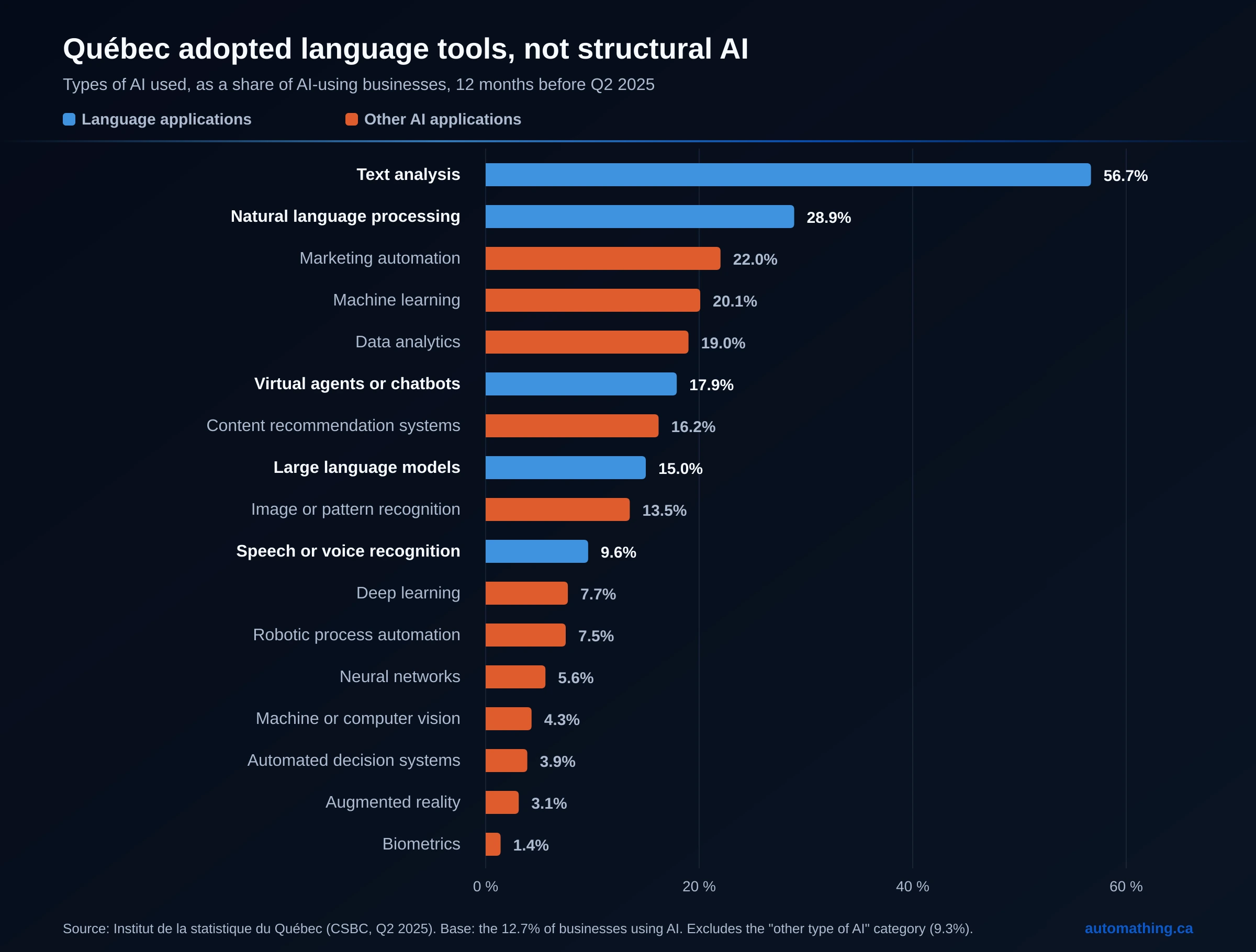
Among AI users, text analysis leads by a wide margin (56.7% of mentions), followed by natural language processing (28.9%), marketing automation (22.0%), machine learning (20.1%) and data analytics (19.0%). Virtual agents and chatbots follow at 17.9%, large language models at 15.0%.
At the bottom of the table sits precisely what actually transforms an operation: robotic process automation (7.5%), computer vision (4.3%), automated decision systems (3.9%).
Translation: Québec has adopted language tools, not AI in the industrial sense. It's real and useful, but barely differentiating: an assistant that drafts and summarizes is available to any competitor for a few dollars a month. Those 3.9% running automated decision systems, by contrast, measure the share of businesses that have handed a recurring decision to a machine and wired it into a process. That's where durable advantage lives, and almost nobody is there.
An important methodological note: these percentages are shares of AI-using businesses, not of all businesses. "56.7% for text analysis" means 56.7% of the ~12.7% who use AI, or roughly 7% of Québec businesses.
It's exactly this step, from tool to agent system wired into the process, that separates a company "doing AI" from a company that AI makes structurally faster.
AI adoption by industry sector in Québec
The 12.7% average conceals very large sectoral spreads.
The heaviest users (finance and insurance, information and cultural industries, professional, scientific and technical services) post usage rates of 36.9% to 55.0%.
At the other end:
- Agriculture, forestry, fishing and hunting: 0.3%
- Accommodation and food services: 1.9%
- Construction: 2.3%
- Transportation and warehousing: 2.9%
AI in Québec is currently an office-work phenomenon, concentrated in the sectors that already handle information for a living. The sectors carrying a major share of the province's employment and economic activity are, statistically, absent from it.
For an owner in one of those sectors, that reads two ways. The bad news: no peer ecosystem, few local references, few specialized vendors. The good news: a competitive advantage that remains entirely available, in a market where more than 97% of direct competitors use no AI application at all.
AI use by company size: the small-business paradox
You'd expect AI to be a large-organization affair rather than an SME one. The data confirms a gap: 26.1% usage among businesses with 100+ employees against 12.2% among those with 1 to 4. But the ratio is 2.1x, not 10x. It isn't the chasm the prevailing narrative implies.
And the measured effect runs the other way. AI moderately or largely reduced tasks previously performed by staff in 37.7% of Québec businesses, a share that rises to 37.9% among businesses with 1 to 4 employees.
The smallest businesses adopt half as much and report at least as much gain. Which makes sense: on a team of three, two hours recovered per day is a far larger fraction of available time than in an organization of two hundred. The constraint isn't the potential, it's the capacity to start.
The barriers to AI adoption in Québec are not technological
The last block of ISQ data is the most useful for acting on. Among Québec businesses that did not invest in their digital infrastructure, the three main obstacles cited are:
- High implementation cost: 27.2%
- Uncertainty about return on investment: 19.3%
- Lack of specialized knowledge: 14.3%
None of these three is a technology problem. They are a budget problem, a scoping problem and a skills problem.
The mirror image is even more telling. To get AI into production, businesses had to develop new workflows (37.2%), train existing staff (36.7%) and buy cloud services or storage (31.2%).
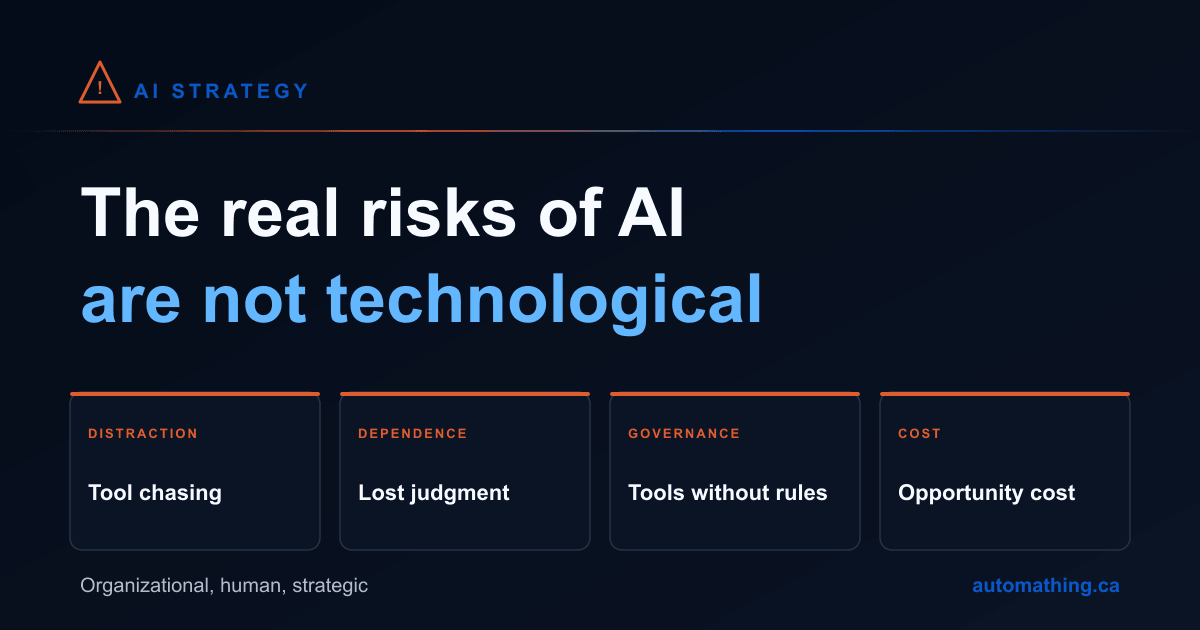
The real work, the work that decides success or failure, is organizational: redefining a process, training people, putting data in order. The model itself can simply be bought. That's precisely why so many projects die after a successful demo. The risks that derail an AI project are rarely technological, and the four questions to ask before any AI project exist to clear them before any budget is committed.
What these statistics change for a Québec business
Three practical conclusions.
1. The gap is one of intent, so it closes with a decision. Québec's deficit isn't a deficit of means: businesses here invest as much as Ontario's in digital overall. It comes down to where AI sits among priorities. That's a leadership decision, not an IT budget.
2. The entry threshold is low, but the differentiation threshold is elsewhere. Adopting a language tool puts you level with the 12.7%. Automating a recurring decision puts you in the 3.9%. The two demand different effort, and produce different advantage.
3. Start with the process, not the technology. Every stated barrier (cost, ROI uncertainty, skills) is addressed upstream of the technology choice: by identifying the right process to automate first, pricing its ROI before committing, and using the Québec tax levers that cut the net cost of a well-scoped project. We covered those programs in our tax credits and grants guide.
For what "doing AI" actually means once you're past the demo stage, our piece on applied AI in business picks up where this analysis leaves off.
Methodology, quality ratings and data limits
The ISQ presents this publication as an "exploratory portrait" of its own accord. Three caveats therefore apply, and we'd rather name them.
The survey is cross-sectional. Within a given year, the CSBC surveys different businesses each quarter. The ISQ states explicitly that the second and third quarters of the same year cannot be compared directly. Every comparison in this article is therefore quarter-to-matching-quarter year over year (Q2 2024 → Q2 2025, Q3 2024 → Q3 2025).
Quality ratings vary. The ISQ assigns a rating to each estimate. The jump in text analysis, from 20.1% to 56.7%, carries a "D" rating (acceptable) for 2025 against "C" (good) for 2024: the increase is real and large, but its exact magnitude should be read with caution. The headline estimates (12.7%, 13.1%) carry an "A" rating (excellent).
Reference periods differ between sections. The questions on investment outlook do not cover the same window as those on actual use. The detail is set out in the ISQ's CSBC methodological notes.
None of these limits weakens the central finding: the intent gap between Québec and Ontario is measured on excellent-quality estimates, and it is far too wide to be sampling noise.
Frequently asked questions
What percentage of Québec businesses use artificial intelligence?
According to the Institut de la statistique du Québec, 12.7% of Québec businesses used AI applications for production purposes in the 12 months preceding the second quarter of 2025, up from 9.4% a year earlier. A further 13.1% planned to use AI in the 12 months following the third quarter of 2025.
Is Québec behind Ontario on AI?
Not in level: 12.7% in Québec against 13.3% in Ontario, a negligible gap. The lag is in the dynamic. Annual progression was 3.3 points in Québec against 7.8 points in Ontario, and 22.6% of Québec businesses consider investing in AI tools important, against 33.1% in Ontario.
Which sectors use AI the most in Québec?
Finance and insurance, information and cultural industries, and professional, scientific and technical services, with usage rates ranging from 36.9% to 55.0%. At the other extreme, agriculture (0.3%), accommodation and food services (1.9%), construction (2.3%) and transportation and warehousing (2.9%) are effectively absent.
What types of AI do Québec businesses use?
Mostly language applications. Among AI-using businesses, 56.7% mention text analysis, 28.9% natural language processing and 15.0% large language models. More structural applications remain marginal: robotic process automation at 7.5%, automated decision systems at 3.9%.
What are the main barriers to AI adoption in Québec?
High implementation cost (27.2%), uncertainty about return on investment (19.3%) and lack of specialized knowledge (14.3%). These are organizational and financial obstacles, not technological ones.
Does AI actually save businesses time?
In 37.7% of Québec businesses using it, AI moderately or largely reduced tasks previously performed by staff. The share is slightly higher among businesses with 1 to 4 employees (37.9%).
Adopting AI in Québec: where to start
The ISQ data describes a market where almost everyone is waiting. For a business that decides not to wait, the window is unusually wide: in most sectors direct competitors aren't moving, and advantage no longer turns on access to the technology but on the ability to wire it into a real process.
We help Québec businesses make exactly that move: identify the process that justifies the investment, price it, and ship something that holds up in production. Book a free discovery call and we'll look together at where your first measurable gain sits.
Data source: Institut de la statistique du Québec, Adoption et utilisation de l'intelligence artificielle par les entreprises au Québec en 2024 et en 2025. Portrait exploratoire, by Pascasie Nikuze, released 28 November 2025. Figures drawn from Statistics Canada's Canadian Survey on Business Conditions (CSBC), second and third quarters of 2024 and 2025, adapted by the ISQ.