AI in Business: 4 questions to ask before any AI project
Bolting AI onto a poorly structured business is like strapping a rocket engine to a broken-down car. It's loud, it's impressive, but it doesn't move forward. Worse: it might blow everything up.
AI is everywhere in executive conversations today, regardless of company size or sector. We don't talk about digitalization anymore. We talk about AI in every steering committee, every RFP, every annual budget. And yet, according to a widely cited 2025 MIT study, roughly 95% of enterprise generative AI projects produce no measurable return. That number should stop any leader tempted to "do AI" cold. It mostly doesn't, because it's inconvenient.
This article lays out a concrete AI strategy for any business: why your structure matters more than the model, the four questions to answer before the first dollar is spent, and, for organizations based in Quebec, the tax credits that make a well-scoped AI project far more affordable.
The real problem isn't AI. It's what sits underneath.
AI is an accelerator. And accelerators, by definition, amplify what you feed them. If your processes are clear, documented and aligned, AI will save you a remarkable amount of time. If your processes are vague, fragmented, or only live in the heads of two key people, AI will simply industrialize the chaos. It will make your mistakes faster, more frequent and harder to fix.
Plenty of companies want to "do AI." They automate, they test copilots, they integrate models. But they never fix what was already broken. The result: a brilliant demo, a silent failure in production.
The core idea: AI doesn't replace a broken structure. It exposes it, faster and more brutally than any internal audit ever could.
Four questions to ask before adding AI
Before investing in technology, invest in clarity. Here are the four questions every leader should put to their executive team, and be able to answer in under five minutes.
1. Where are the real inefficiencies?
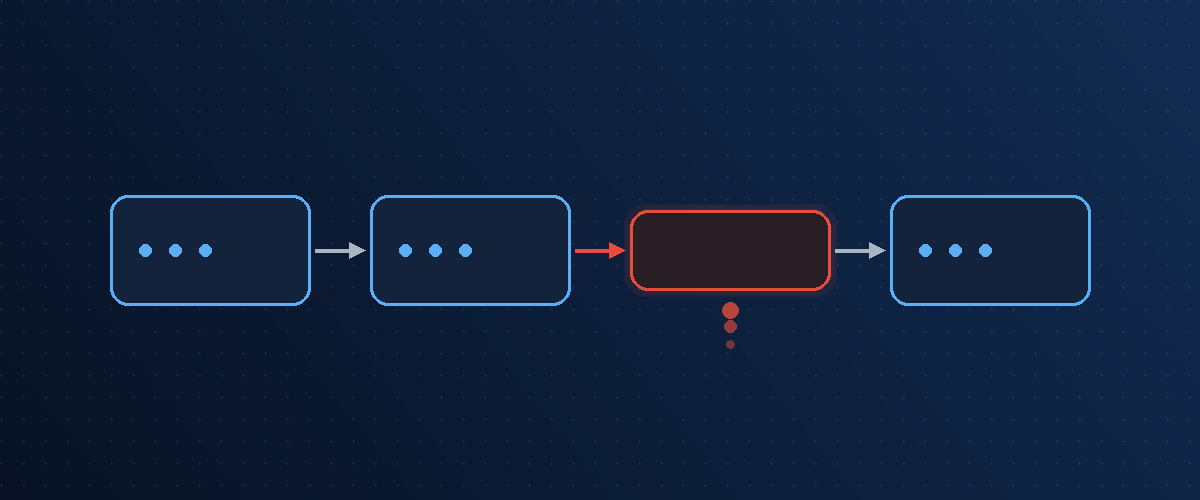
Have you mapped your processes end to end, or are you still running on "invisible duct tape," those informal workarounds you only notice when a key employee goes on vacation? Until the bottlenecks are identified, AI will only speed up the work around the real problem, without ever solving it. That's exactly what our APO Diagnostic reveals: a simple framework to see where your business actually bleeds before you add anything. Once you have that list, our 3-factor scoring framework tells you which bottleneck to fix first.
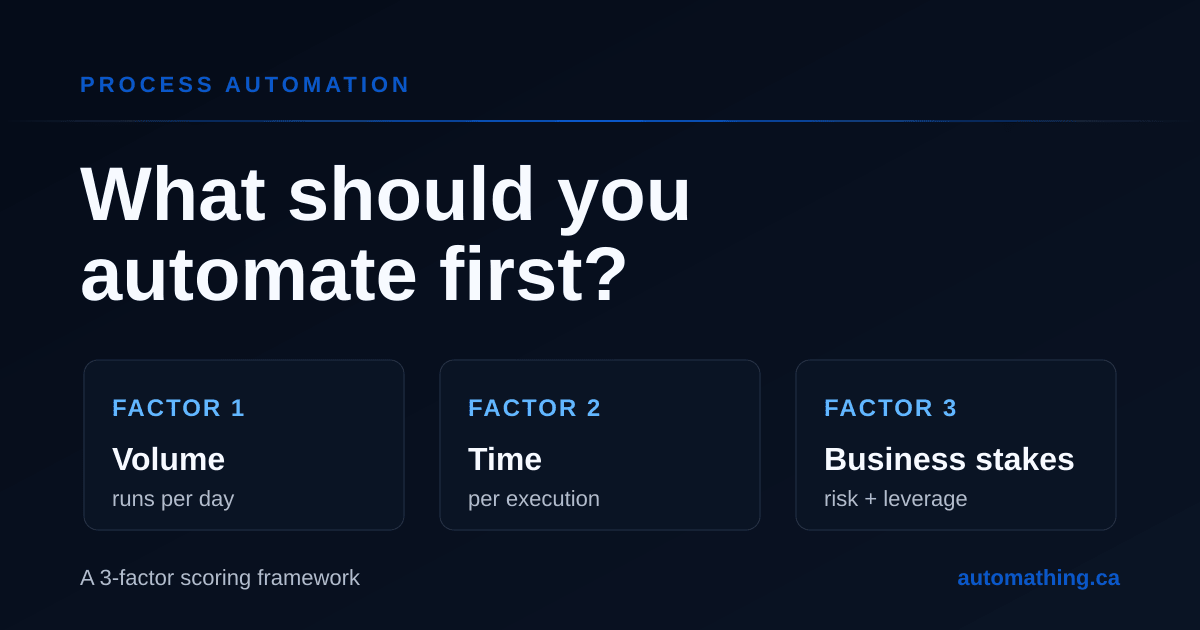
How to Choose What to Automate First (in 3 Factors)
How to choose what to automate first in your business: a 3-factor scoring framework (volume, time, error cost) with a worked SMB example and a free template that pays back in 90 days.
2. Are the teams aligned?
A good process isn't just technology. It's humans who know when to step in, when to step back and when to automate. If your teams don't share the same definition of success, no AI model will fix that disagreement. It will harden it. Alignment is the human prerequisite that always precedes the tool.
3. What concrete outcome are you after?

Lower costs? Better customer experience? Faster operations? "Doing AI" isn't a goal, it's a slogan. Without a precise metric and a measurable hypothesis, you don't have a project. You have a marketing experiment. The strongest projects look much more like the concrete cases we document in our AI for Quebec SMEs guide: a specific bottleneck, a measurable gain, a documented ROI.
4. Is your governance ready for your AI?

As governance expert Eric Ste-Marie reminds us, Quebec's Law 25 already requires (art. 12.1) that an organization be able to explain any automated decision to the person it affects. Without a clear framework for data ownership, decision traceability and compliance, you simply cannot deliver that explanation. His shortcut sums it up: AI on a poorly structured process is an operational risk; AI on a poorly structured process with no governance framework is an indefensible one.
Regional bonus: tax credits available in Quebec
The principles above apply to any organization, regardless of size or jurisdiction. But if your business is based in Quebec, the financial math shifts: a well-scoped AI project can stack multiple tax credits that materially reduce its net cost.
According to the Institut de la statistique du Québec, 12.7% of Quebec businesses used AI applications for production purposes in the 12 months preceding Q2 2025, with the rate dropping to 12.2% for the smallest businesses (1 to 4 employees). At the same time, the Quebec government is actively pushing digital transformation through the Plan PME 2025-2028 and several powerful tax incentives.
Three Quebec credits materially change the financial math of an AI project run locally:
- CRIC: the credit for research, innovation and commercialization offers up to 30% refundable on the first million dollars of eligible spending, well suited to AI projects with an R&D component.
- Federal SR&ED: up to 35% refundable for a Canadian-controlled private corporation, stackable with the CRIC.
- CDAEIA: the e-business development credit, recently refocused on AI-integrated solutions, supports up to 30% per eligible employee.
Combined, these programs can cut the net cost of a well-scoped AI project by 30 to 50%. The full breakdown lives in our 2026 tech tax-credits guide.
Here's the trap most companies don't see coming: those credits don't repair a broken structure. They fund the industrialization of poorly designed processes. An organization that answers the right questions before touching a model can combine tax credits with sound structure and deliver real ROI. One that skips the structure step pays twice: once for the failed project, once in lost internal trust for the next attempt.
The difference between a strategy and just noise
If you can't answer those four questions clearly, you don't have an AI strategy. You have AI-flavoured noise. And noise is expensive: licenses, consultants, management time, technical debt. Worst of all, it destroys internal trust. When the third POC fizzles, your teams stop showing up to "try out" the fourth.
Most of that noise comes down to the same handful of organizational failure modes. We break them down in The Real Risks of AI Are Not Technological.
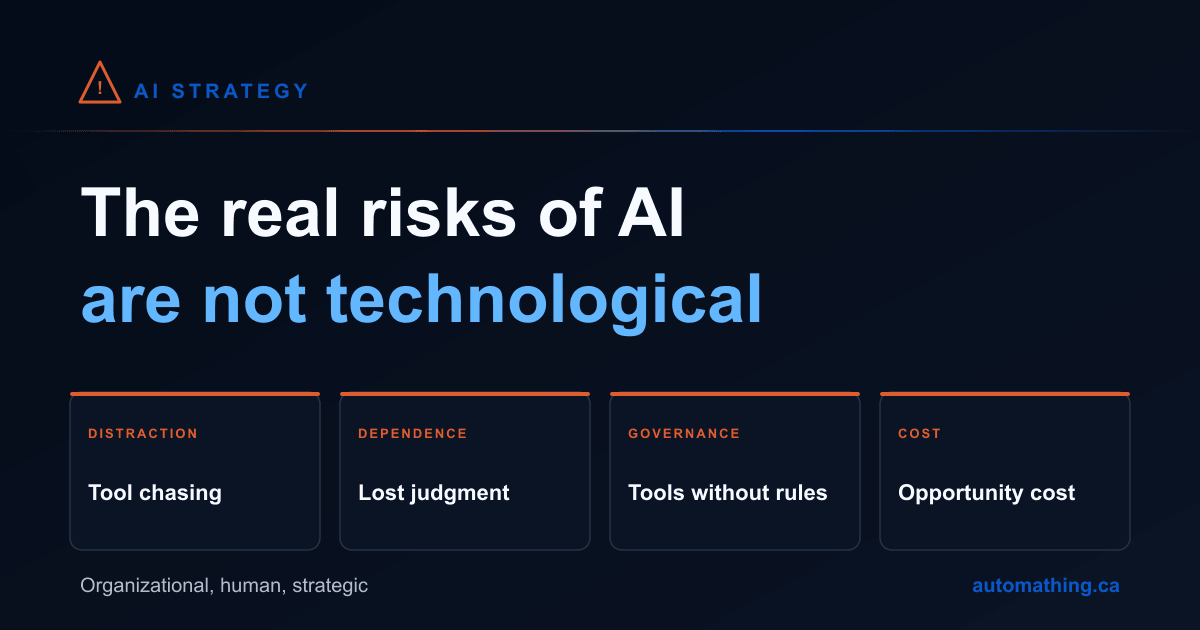
The Real Risks of AI Are Not Technological
A company can succeed technically at AI and still fail to create value. The biggest risks are organizational, human, and strategic. Here is what leaders need to watch.
A real AI strategy always starts with an honest operational diagnostic. Which processes make money? Which ones bleed? Where do you lose money quietly every month? That work, usually unglamorous, is the difference between a company that adopts AI and a company that uses it as an actual growth lever.
AI isn't an answer. It's a revealer.
Here's the truth most vendors won't tell you: when a model starts producing inconsistent results, the model is almost never the culprit. It's the data you feed it, the processes it automates and the human decisions you never clarified.
The good news is that this exposure is an opportunity. It forces you to fix what should have been fixed long ago. The companies that come out ahead in this AI wave aren't the ones that deployed the most models. They're the ones with the courage to look their operations in the eye, simplify, standardize, and then, only then, automate intelligently. That's the approach we take in our process automation engagements for SMEs: structure first, accelerate second.
In short
Before launching your next AI project, ask yourself one question: if I removed the AI from the equation, would my process still make sense? If the answer is no, you don't have an AI problem. You have a structure problem. And no model, however advanced, will solve it for you.
AI is neither saviour nor threat. It's a mirror. And what it reflects depends entirely on what you built before it.
Frequently asked questions
Should we wait until our processes are perfect before adopting AI?
No. The goal isn't perfection. It's clarity. You need to know what your process should do, where the bottlenecks are, and who owns each decision. With that map in hand, you can pilot AI on a single, well-scoped step. Waiting for a perfect operation is just another way to never start.
How do we know we're ready for an AI project?
Three signals: you can name the bottleneck in one sentence, your data on that process is digital and reasonably clean, and there's a human owner accountable for the outcome. If any of those three is missing, fix that first. It's faster and cheaper than discovering it in production.
Where do failed AI projects usually break?
Almost never in the model. They break in the data quality, the lack of clear governance, and the absence of measurable success criteria. A McKinsey survey and the 2025 MIT study both point to the same pattern: technically successful pilots that fail to translate into business value because nothing was structured around them.
Is generative AI (like ChatGPT) enough for our business?
For general tasks, sometimes. But for automating a business process on your own data while staying compliant with Quebec's Law 25, an integrated and supervised solution is usually required. The question isn't the model. It's the operating context.
From diagnostic to action
At Automathing, every engagement starts with the same reflex: understand the structure before recommending the technology. Our APO Diagnostic gives you a fast, honest read on your business (analysis, planning, operations) so you know whether you're ready for AI, or whether the foundations need work first. Book a free discovery call and we'll figure out the most useful next step together.

About Orléando Dassi
CEO & Co-Founder
Orléando drives business strategy, product development, marketing initiatives, and customer experience. He holds a bachelor's degree in software engineering, 11+ years of IT experience, an MBA in progress at Université de Sherbrooke, and an ASP in business launch from CFP 24-Juin.
Related articles
The Real Risks of AI Are Not Technological
A company can succeed technically at AI and still fail to create value. The biggest risks are organizational, human, and strategic. Here is what leaders need to watch.
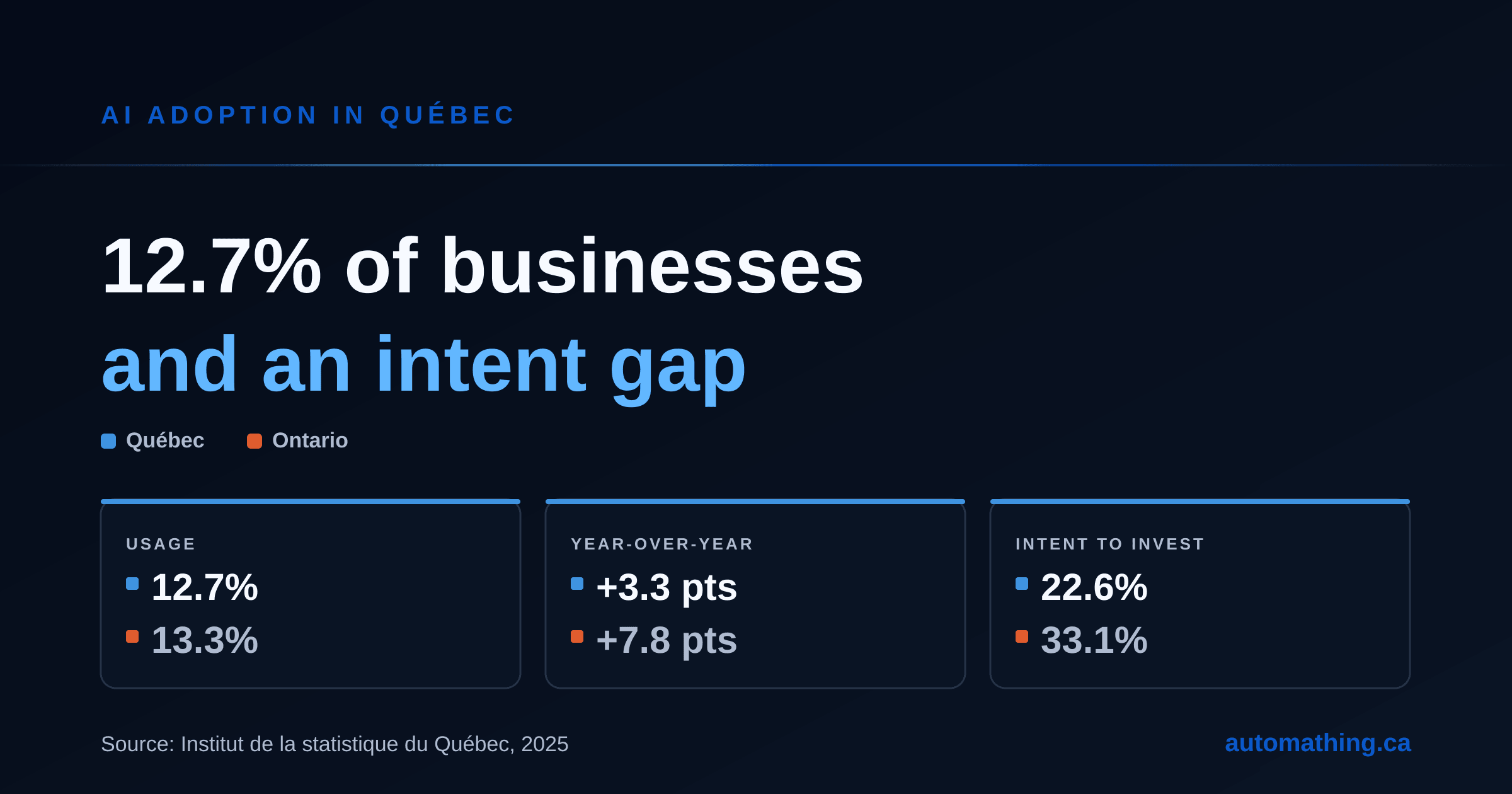
AI Adoption in Québec: 12.7% of Businesses in 2025
ISQ 2025 data: Québec is not behind on AI adoption, it is behind on intent. An analysis of the numbers and what they mean for businesses here.
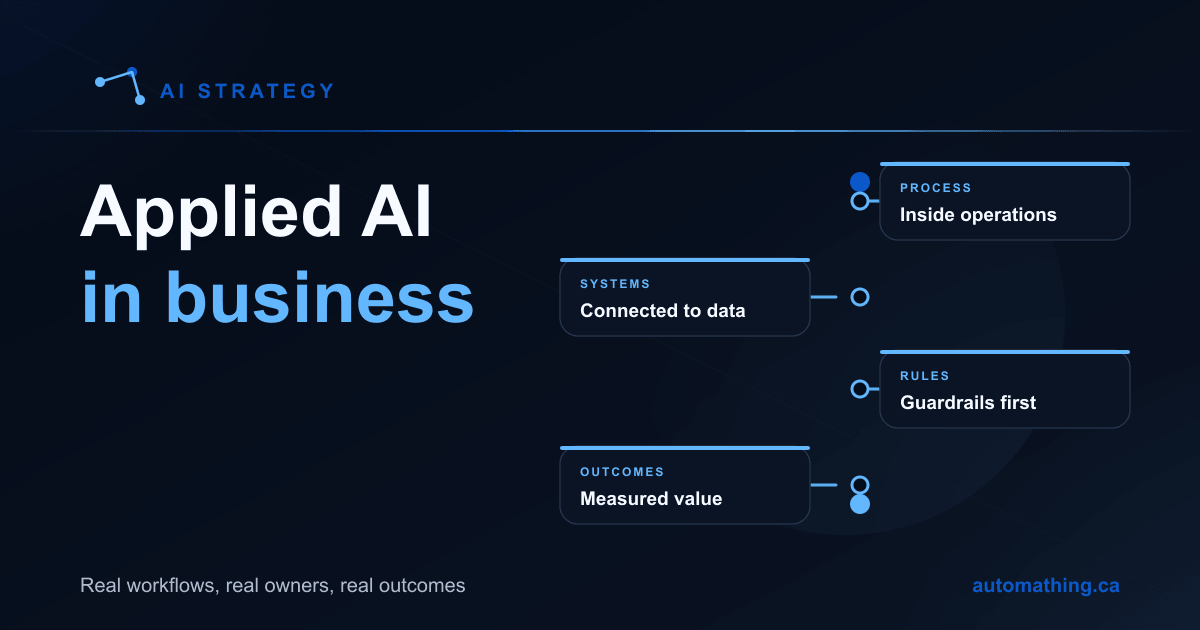
Applied AI in Business: What It Actually Means and Where It Creates Value
Applied AI explained in practical business terms: what it is, what separates it from demos, where it creates value, and how to adopt it without creating operational risk.