Digital transformation for Quebec SMEs in 2026: roadmap and obstacles
"Digital transformation" is one of those phrases everyone uses and no one defines. For a Quebec SME, it doesn't mean "buying technology." It means rethinking how work gets done so that technology eliminates friction, frees people, and lets you grow without breaking everything.
With the Quebec government's 2025-2028 SME Plan and the funding programs that accompany it, 2026 is a particularly favourable moment to get started. This guide gives you a concrete five-step roadmap, the obstacles that sink most projects, and the list of available financial support.
What digital transformation is not
Let's dispel three myths first:
- It's not a one-time project. It's a continuous change in how you work, not a piece of software you install once.
- It's not reserved for large companies. SMEs often have the advantage of agility: fewer layers, faster decisions.
- It's not "digitize everything at once." "Big bang" transformations fail. The winners advance in measurable steps.
The 5-step roadmap
Step 1: Diagnostic. Where are you really?
Before investing, map your situation: which processes are manual, where the bottlenecks are, what systems exist and how (badly) they communicate. Good news: this diagnostic is often funded by programs like ESSOR's Audit 4.0. It's the ideal starting point because it guides everything else and unlocks the subsequent funding streams.
Step 2: Prioritization. What's the quick win?
Don't start with the biggest project, but with the one offering the best impact/effort ratio. Automating a frequent, costly process automation delivers a visible result in a few months and builds internal buy-in, which is essential for what follows.
Step 3: Foundations. Data that flows
Most SMEs have "silos": the CRM doesn't talk to accounting, which doesn't talk to inventory. Connecting these systems through a clean integration is often the most structural investment: it eliminates re-entry, makes data reliable, and makes every subsequent project easier.
Step 4: Building. Existing tool or custom
For each need, decide between a ready-made solution (SaaS) and custom. SaaS wins for the commonplace; custom wins when your process is a competitive advantage or when no tool fits your reality.
Step 5: Adoption and continuous improvement
Technology transforms nothing if no one uses it. Train, support the change, measure real usage, and iterate. A successful transformation has no end: it becomes a permanent capacity for improvement.
The obstacles that sink most projects
The labour shortage
Paradoxically, it's both the reason to transform and the main brake: you lack time and internal expertise. The solution: start small, funded, and lean on an external partner for execution.
Lack of scoping
Launching a project with no measurable objective guarantees drift. Each initiative must have a clear indicator (hours saved, time reduced, errors avoided).
Resistance to change
Employees passively sabotage what they don't understand or what threatens them. Involve them early, show them what they gain, and turn them into allies.
Underestimating integration and maintenance
Many budgets forget the cost of connecting systems and maintaining them. Plan for them from the start to avoid nasty surprises.
Choosing the technology before the problem
"We need AI / an app / an ERP" is the wrong starting point. Start from the problem, the technology follows.
The funding programs (2026)
Quebec actively supports SME digital transformation. The main levers in 2026:
- ESSOR program (Investissement Québec): up to 50% of eligible costs for a digital diagnostic or plan (up to $20,000) and for its implementation (up to $50,000), with larger streams for major projects.
- 2025-2028 SME Plan: the government strategy that structures several productivity and digitization supports.
- Tax credits: CRIC (up to 30% refundable), C3i (15–25% for management software and equipment) and federal SR&ED. Details in our tech tax-credits guide.
Winning strategy: chain the programs. A funded diagnostic establishes the plan, which justifies a funded implementation project, itself supported by tax credits on the development portion.
An example 18-month journey
To make this concrete, here's a typical journey for a 30-employee services SME.
Months 1-2: Diagnostic. A digital audit (50% funded) reveals that the team wastes huge amounts of time re-entering data between the web form, the CRM and accounting, and that management reports take two days to compile each month.
Months 3-6: First win. The data sync between the three systems is automated. Immediate result: re-entry disappears, errors drop, and internal buy-in climbs because everyone sees the benefit.
Months 7-12: Foundations. A unified dashboard is built that compiles sales and operations data in real time. Management makes decisions on fresh figures rather than a two-week-old report.
Months 13-18: Capacity. With clean, connected data, a layer of intelligence is added: follow-up prioritization, demand forecasting. The transformation has become a permanent capacity, not a finished project.
Each step funds and justifies the next. It's the opposite of the "big bang": small, measured, cumulative.
The role of a strategic partner
Most SMEs don't need to hire a full technology team: they need a partner who understands both the technology and the business, and who can execute in stages. That's precisely the role of our tech strategy services, turning a vague ambition into a concrete, funded, deliverable roadmap.
Why the sequence matters more than the tools
It's tempting to judge a transformation by the technology it ends up with (the new ERP, the dashboard, the AI layer). But the businesses that succeed and the ones that stall often buy similar tools; what separates them is the order in which they move. Start with a flashy project before the data foundations are in place and you build something impressive that runs on unreliable inputs, distrusted within months. Start with a quiet integration that makes the data clean and connected, and every later project becomes faster, cheaper and more credible. The roadmap isn't a list of purchases; it's a sequence where each step earns the right to the next.
This is also why the funded diagnostic is more than a formality to unlock a grant. Done seriously, it forces the uncomfortable conversation about where work actually breaks down, usually not where leadership assumes. The bottleneck is rarely the absence of a tool; it's a re-entry step, an approval that waits days, a report nobody trusts. Naming the real friction first, before choosing any technology, is what keeps a transformation from becoming an expensive collection of software that solves problems you didn't have. Problem first, sequence second, tools last.
Frequently asked questions
Where do I start a digital transformation in an SME?
With a diagnostic, ideally funded by a program like Audit 4.0. It reveals your bottlenecks and steers investments toward the best-ROI projects.
How long does a digital transformation take?
It's a continuous process, but the first concrete wins should arrive in 3 to 6 months. Be wary of projects that promise to change everything at once.
What budget should an SME plan for?
It depends on the scope, but starting with a funded diagnostic then a first targeted project lets you begin for a few tens of thousands of dollars, part of it covered by the programs.
Build your roadmap
Digital transformation succeeds when it's gradual, measured and intelligently funded, not when it's spectacular. Start by understanding where you are, choose a first win, connect your data, then move forward.
We support Quebec SMEs through this process, from diagnostic to execution, via our tech strategy services. Book a free discovery call and we'll sketch out your roadmap and the applicable funding programs together.

About Orléando Dassi
CEO & Co-Founder
Orléando drives business strategy, product development, marketing initiatives, and customer experience. He holds a bachelor's degree in software engineering, 11+ years of IT experience, an MBA in progress at Université de Sherbrooke, and an ASP in business launch from CFP 24-Juin.
Related articles
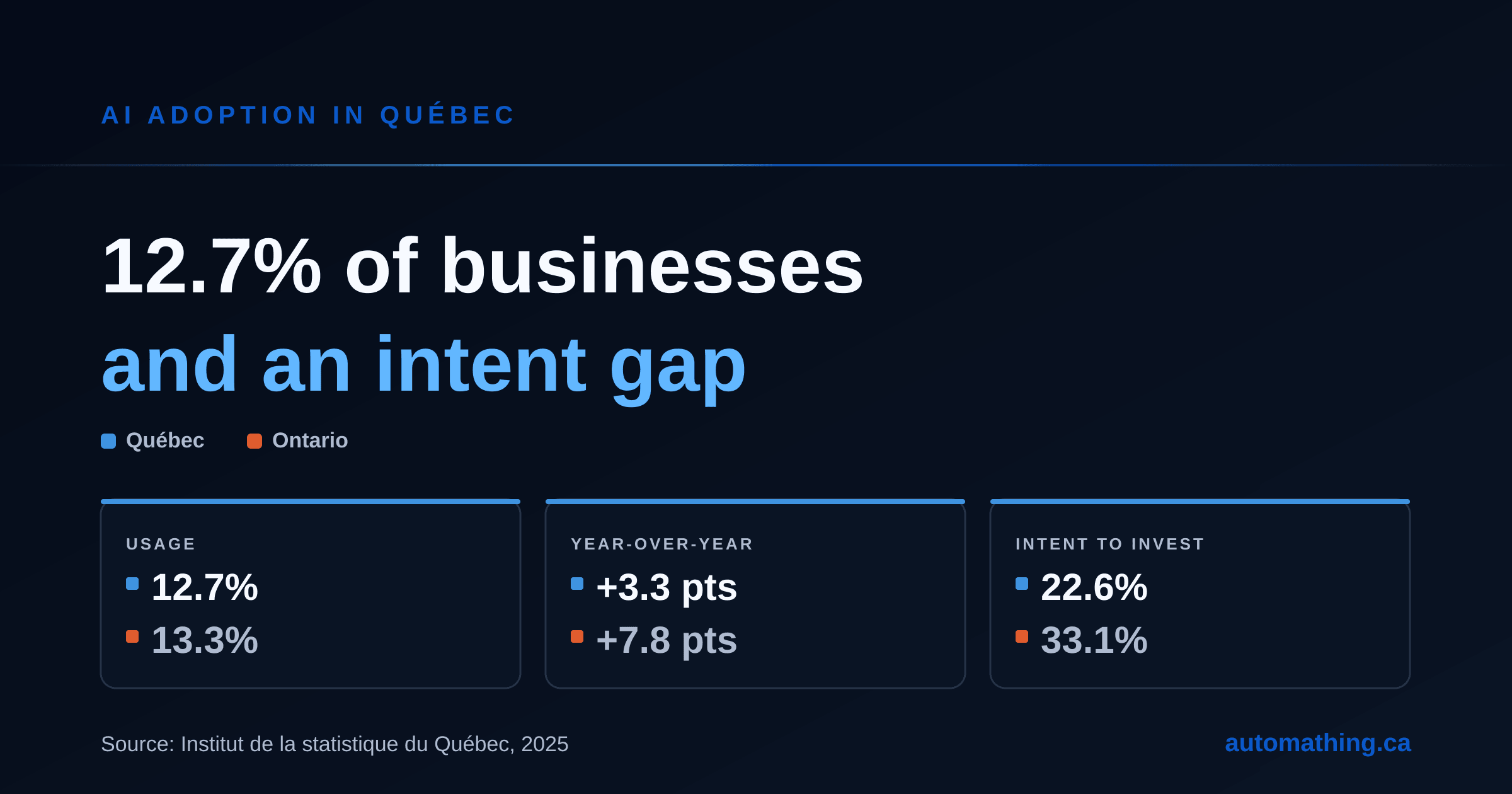
AI Adoption in Québec: 12.7% of Businesses in 2025
ISQ 2025 data: Québec is not behind on AI adoption, it is behind on intent. An analysis of the numbers and what they mean for businesses here.

AI for Quebec SMEs: Real Cases, Not Hype (2026)
AI for Quebec SMEs without the hype: concrete use cases by industry, what AI won't do for you, realistic ROI and the 2026 tax credits that fund it.
Process Automation for Quebec SMEs: A 2026 Guide
Which processes should you automate first in a Quebec SME? A prioritization matrix, ROI by process type, and the 2026 funding programs (ESSOR, tax credits) that pay for it.