
Custom software is not dead. It simply stopped being the default choice, and honestly, that is a good thing.
For a long time, too many companies commissioned custom software for the wrong reasons: because they wanted "their own system," because a founder liked the idea of owning something proprietary, or because a vendor knew how to sell a technically impressive vision. The result was often the same: heavy projects, long timelines, difficult adoption, and expensive software built to solve needs that the market had already solved well in SaaS.
Today, we have the opposite bias. The dominant reflex is now: if a SaaS product exists, use the SaaS product.
In many cases, that is absolutely the right answer. Whether the need is accounting, email, e-signature, project management, payroll, or payments, renting a mature tool is usually smarter than rebuilding what the market has already standardized.
But there is a tipping point many companies recognize too late. It comes when software stops being support and starts being constraint, when teams spend more time working around the tools than moving forward, when subscriptions keep stacking cost without reducing complexity, and when the business logic that actually makes you win no longer fits cleanly inside a generic product.
At that point, the question is no longer "is custom software more prestigious?" The real question becomes: when does continuing to rent become more expensive, more rigid, and riskier than building the right custom layer?
That is the question this article is really about. If you want the broader decision framework first, our full guide on custom software vs. SaaS covers the bigger picture.
Custom Software vs. SaaS: Which One Should Your Business Choose?
Compare cost, flexibility, deployment speed, and operational fit to decide when SaaS wins and when custom software becomes the better call.
When to choose custom software: the wrong way to think about it
The bad version of the argument usually sounds like this: our needs are special, therefore we need custom software. Most of the time, that is false.
A slightly unusual need does not justify a software project. A preference for a different interface does not justify one either. Not even a handful of SaaS frustrations. Custom software is not the natural reward for being annoyed by a tool; it is a strategic decision that becomes justified when software touches execution, margin, control, or the company's ability to scale cleanly.
In other words, the right question is not: are our current tools perfect?
The right question is: are the limits of our current tools starting to cost more than replacing them intelligently?
When the answer becomes yes, custom deserves to return to the conversation in a serious way.
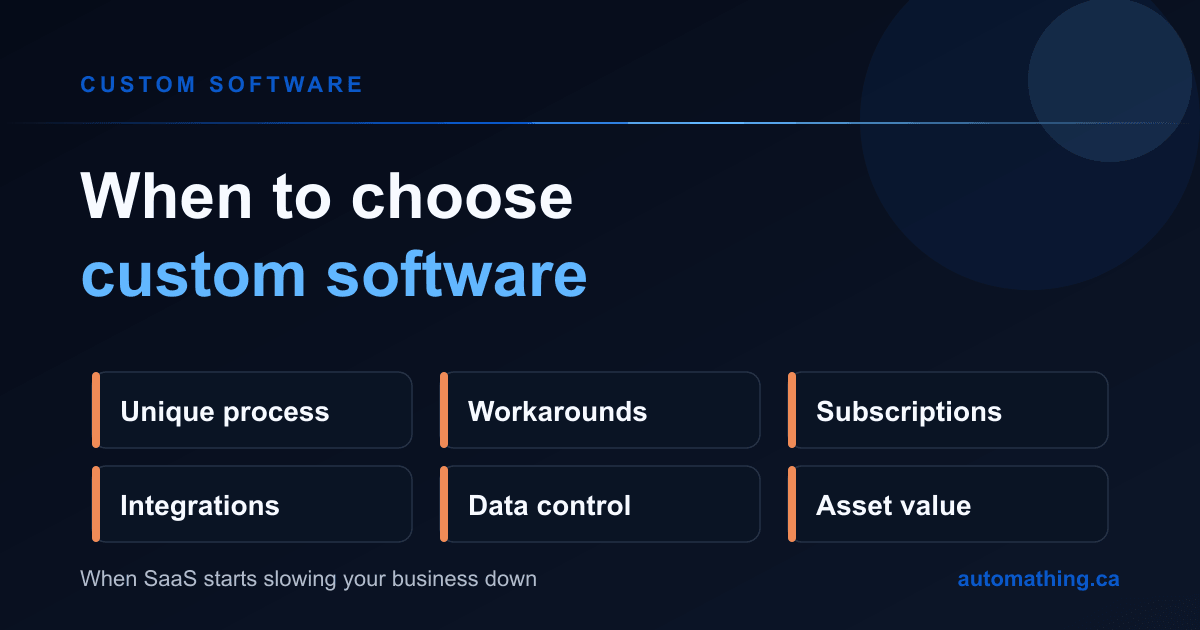
1. Your process is not just "different"; it creates real advantage
Some companies have unusual needs; others operate in a way that is itself part of their competitive advantage. The difference between those two situations is enormous.
If your commercial process, delivery model, operational flow, or service logic allows you to respond faster, handle more complex cases, reduce errors, or deliver an experience competitors cannot easily match, you do not merely have a "special workflow." You may have business logic worth protecting and amplifying.
A generic SaaS product can support a standard process with a few adjustments. It becomes a drag when it forces you to simplify the very part of the business that creates value.
A typical example: a B2B company wins deals because it can quote complex requests quickly, with multiple exception paths, several validations, and tight coordination between sales, operations, and delivery. If its quoting tool forces every case back into a simplified template, that is not just annoying. It directly erodes the company's edge.
The simplest test is this:
If you stripped away the current tools completely, would a meaningful part of your performance still depend on your unique way of processing information, exceptions, or decisions?
If yes, there is a good chance the core of that process deserves more than a generic SaaS product.
2. Your workarounds are no longer exceptions; they have become the system
The pattern is usually the same: an Excel file beside the CRM, a CSV export to finish the task manually, copy-paste between platforms, and a key employee who "knows how it really works."
These are not just minor operational annoyances. They are often symptoms of a deeper misalignment between the way the business works and the tools that are supposed to support it.
The critical moment is not when a workaround appears. The critical moment is when the workaround becomes the normal procedure.
At that point, your company is effectively running on a shadow system:
- one part in the official SaaS tool
- one part in parallel spreadsheets
- one part in employees' heads
- one part in fragile automations added over time
That shadow system costs more than it looks like on paper. It consumes time, creates mistakes, reduces traceability, complicates onboarding, and makes the organization fragile whenever a key person is absent.
In some cases, a well-designed systems integration project is enough to fix the problem. But if the workarounds exist because your tools cannot represent your business logic cleanly, integration alone does not solve the root issue. It only connects existing limitations.
3. Your SaaS stack is starting to make you rent fragmentation
SaaS looks inexpensive at the beginning because most companies evaluate each subscription in isolation: $50 here, $99 there, an add-on module, a few seats, a paid connector, and an outside consultant to configure everything. Taken one by one, nothing seems dramatic; taken together, it can become a very expensive architecture.
The true cost of a SaaS stack is not just the sum of the subscriptions. You also need to count:
- configuration and plan-upgrade costs
- paid connectors
- support and maintenance for your automations
- re-entry work
- the time spent reconciling data that lives in different places
Leadership often underestimates this because the cost is spread across multiple teams and budget lines. In practice, though, this is one of the most common triggers for custom software.
We see the same pattern repeatedly: at first, the company buys a few tools to move quickly. Then, as it grows, it adds another layer here, another integration there, one more tool to fill a gap, then another to compensate for the previous tool's limits. Three years later, it has not built a system. It has assembled a monthly operational debt.
Custom becomes relevant when you realize you are no longer paying for simplicity. You are paying to hold together a set of pieces that never really wanted to be a system.
At that stage, stop comparing a custom project to one monthly subscription. Compare it to the total cost of fragmentation over three to five years. That is where ROI thinking becomes much more useful than sticker-price thinking. For a more detailed worked example, our guide to custom software ROI walks through the calculation step by step.
4. Your systems need to execute shared business logic, not just exchange data
Many teams say they need "integrations." What they often need is something else: shared logic across several systems. That distinction matters.
A simple integration moves information from one tool to another. Business orchestration makes a decision, triggers several actions, applies rules, manages exceptions, and keeps a coherent audit trail.
Take a concrete example: when a contract is signed, you may not just want to create a client in a CRM. You may need to:
- create a file with a specific structure
- check whether the contract type requires validation
- launch a different sequence depending on service level
- notify two teams but not a third
- block the next stage if something is missing
- leave a trace leadership can actually use
That is not merely a data transfer. It is execution of business logic.
Off-the-shelf connectors, Zapier, Make, or n8n are excellent when the logic stays simple. They become more fragile when they are carrying the core of a multi-system process with complex rules and frequent exceptions.
In that scenario, custom software does not necessarily mean "replace the whole application landscape." It can mean building the orchestration layer missing between the SaaS tools you keep. And very often, that is the smartest compromise: keep the good tools, but take control of the logic that binds them together.
5. Control over your data and rules is becoming a governance issue
At the beginning of a business, the priority is straightforward: make it work. As the company grows, the question changes subtly: who actually controls the system?
Where does the data live? Who can see it? What can be audited? What happens if a vendor changes pricing, permissions, exports, product rules, or roadmap priorities? How far can you enforce your own security, approval, retention, and access logic?
As long as these questions remain secondary, a well-chosen SaaS product does the job extremely well.
But once they become structural, the reasoning changes. The issue is no longer just the tool. The issue becomes governance of the system itself.
That is especially true when:
- several teams handle sensitive data
- decisions need to be traceable
- the company has contractual or regulatory obligations
- access and validation logic is becoming specific
SaaS is not bad by nature. It is simply designed to serve many companies with a standardized level of control. As soon as your requirements move beyond that frame, you start feeling the ceiling.
At that point, custom becomes relevant again not because the company wants things "its own way" in a vague sense, but because governance now needs to match the stakes of the business.
6. You are starting to think in terms of strategic assets, not just rented tools
SaaS gives access, while custom software can create an asset. It is not always the right asset to build, but when it is the right one, the difference is profound.
A well-designed software asset can:
- reduce dependence on multiple vendors
- stabilize the company's operating logic
- make future automations cheaper
- create a cleaner base for AI, integrations, and management visibility
This point is often misunderstood because many companies still frame the choice as "light subscription" versus "big expensive project." A better framing is: keep renting an imperfect stack forever, or invest in the layer that captures the business logic your company actually runs on?
When a system directly affects operations, margin, service capacity, or customer experience, it can be rational to want to own that layer even if you continue renting the rest.
That is why the smartest reasoning is rarely "all custom" versus "all SaaS." It is usually: what deserves to be owned, and what deserves to be rented?
The counter-signal too many people ignore: sometimes custom software would be a mistake
This also needs to be said plainly: many companies consider custom software too early.
Custom is often the wrong decision if:
- your process is still changing every month
- you have not yet clarified how the business should operate
- you are trying to fix a management problem with technology
- your friction mostly comes from poor adoption of the existing tools
- you do not have an internal owner capable of arbitrating priorities
In other words, custom software does not compensate for an undefined operation. It freezes it.
That distinction matters. Build too early, and you often end up with software that is faithful to an immature operating model. Then the business evolves, reality shifts, and the system becomes outdated quickly because too much was coded before the core logic had stabilized.
The right time to build is not when irritation is highest. It is when the business logic is clear enough to structure and important enough to deserve it.
How to decide when to choose custom software
Here is a practical rule. It is not a scientific formula, but a field heuristic: one signal often looks like an annoyance, two signals like growing tension, and three or more like a structural problem.
Custom software deserves a real evaluation when at least three of the following are true at the same time:
- your process is differentiating
- your workarounds are structural
- your subscriptions are mainly financing fragmentation
- your systems must execute shared business logic
- your control and governance requirements are rising
- you want to turn software dependence into a strategic asset
If only one box is checked, you should probably stay in SaaS.
If two are checked, you may need better integration or a cleaner operating setup.
If three or more are checked, it is often time to stop debating the issue abstractly and do real scoping around perimeter, sequencing, ROI, and ownership.
What we most often recommend in practice
The best architecture is rarely ideological.
In practice, what we recommend most often looks like this:
- SaaS for the commodities: email, payroll, accounting, e-signature, standard support tools
- Custom for the differentiating core: business orchestration, customer portals, complex-case logic, critical automations, and structurally important data flows
Put differently: do not rebuild what the market already standardizes extremely well. But do not keep renting the very thing that makes you different if that rental is starting to slow the business down.
Frequently asked questions
Is custom software always more expensive than SaaS?
Up front, almost always. Over the medium term, though, the honest comparison is not against one subscription. It is against the combined cost of multiple tools, integrations, re-entry work, errors, and rigidity. That is where some custom projects become economically rational.
Do you need to replace every existing tool to move toward custom software?
Rarely. The best model is often hybrid. Custom software does not need to replace the entire stack; it can become the layer that orchestrates the core business while standard functions remain in SaaS.
What is the best first step before launching a custom project?
Not development. Scoping. You need clarity on perimeter, expected gains, business rules, adoption constraints, and what truly needs to be owned. That step is what prevents companies from building too wide, too early, or for the wrong reasons.
The real question is not "custom software or SaaS"
The real question is not choosing a camp. It is which part of your system should remain a commodity, and which part has become too strategic to be treated like a simple rental.
Once that distinction becomes clear, the decision gets much cleaner. Custom software stops being either seductive or intimidating. It becomes what it should always have been: an economic and strategic choice in service of a business model.
We help companies do exactly that work: separate what should remain standard, what should be better integrated, and what genuinely deserves a custom layer. If your business is approaching that tipping point, our custom software development work always starts with that scoping step before anyone writes code. Book a free discovery call if you want to assess what truly deserves to be built.