Everyone talks about deploying AI agents. Far fewer talk about what happens after.
In classic systems, we have logs, traces, metrics. We know who did what, when, and why it broke. An entire observability industry was built on top of that: Datadog, Sentry, Grafana. The reflex has been ingrained for years.
With AI agents, that reflex isn't enough anymore. And the problem isn't technical. It's conceptual.
Why an AI agent doesn't crash, it drifts
A service that fails throws an exception, returns a 500, lights up a red dashboard. You see it right away.
An agent doesn't stop when something goes wrong. It hallucinates. It makes a bad call. It picks the wrong tool for the task. It loops silently on an intermediate step. And the whole time, the system keeps returning 200 OK, because from the infrastructure's point of view, nothing failed.
What failed is the reasoning. And reasoning doesn't leave a trace in a classic tech stack. What we need to observe isn't just the output anymore, it's the path that led to it.
What is AI agent observability?
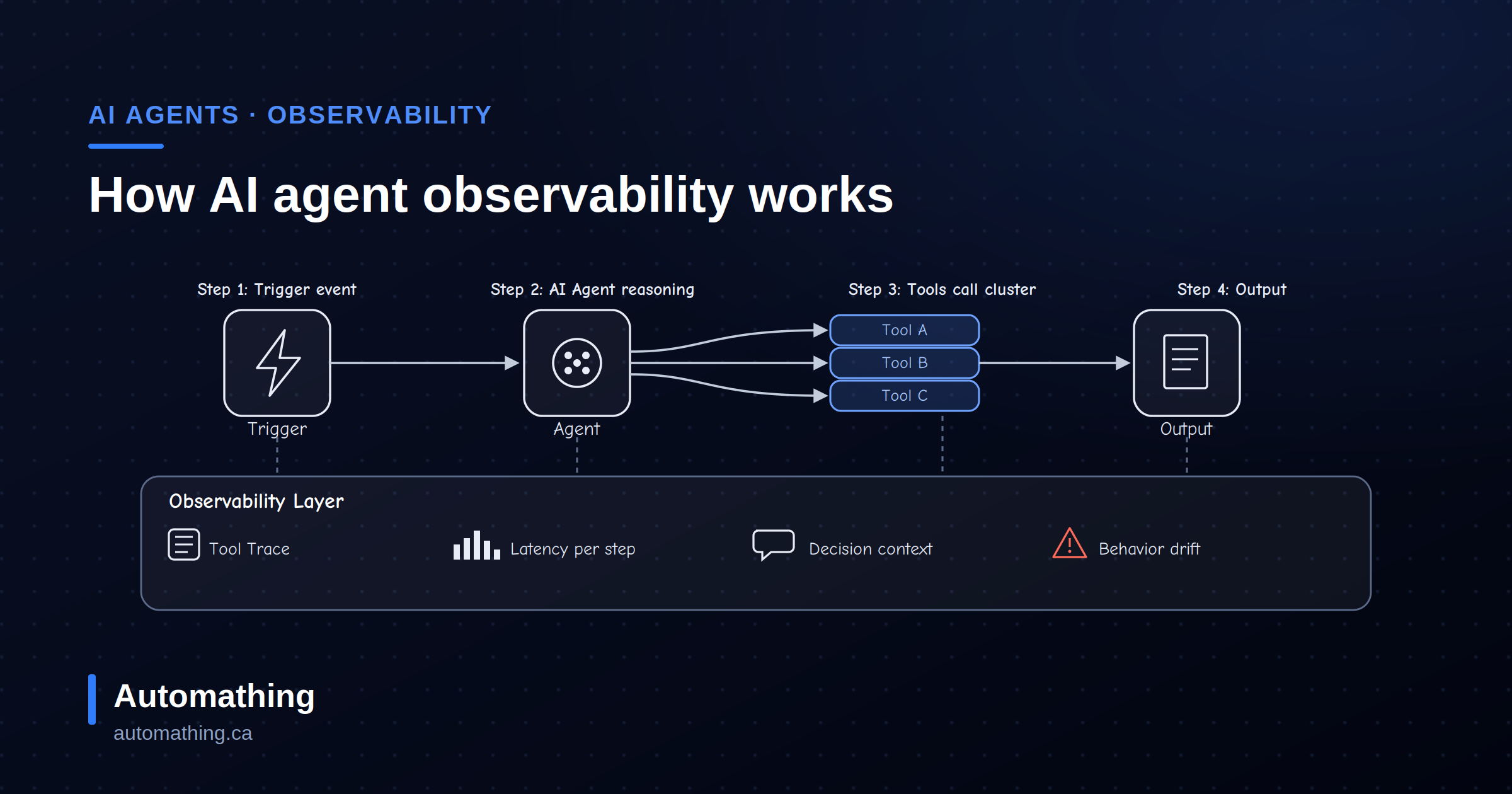
AI agent observability is the ability to trace an agent's reasoning in production, not just its infrastructure health. Where classic monitoring answers "did the service respond, and how fast?", agent observability answers a different set of questions: which tools did the agent call, in what order, with what intermediate decisions, and did that path make sense for the task?
The unit of observation changes. It's no longer the request; it's the run: the full sequence of steps between the moment an agent receives a task and the moment it produces a result. A run can be fast, return a clean output, trigger zero alerts, and still be wrong from the second step onward.
The problem as we lived it with TowerZ's AI agents
At Automathing, the autonomous agents behind TowerZ run in production: they generate content, analyze business data, and orchestrate complex multi-step tasks.
At small scale, we got by with logs, a few manual labels, and a lot of good will. But in practice, it was often client feedback that told us an agent had misbehaved, well before we caught it ourselves. The signal came from the outside, never from our own tooling.
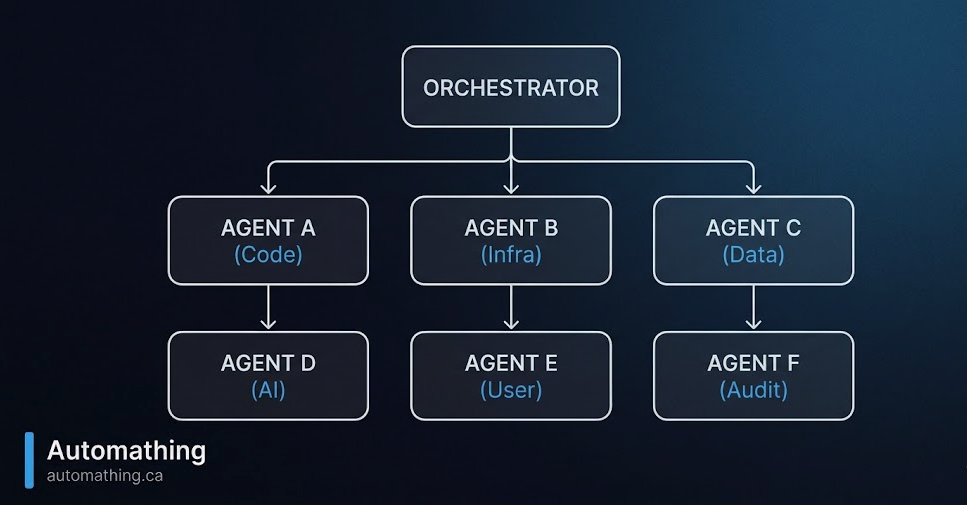
At larger scale, that approach became untenable. More agents, more steps, more tasks running in parallel: it's impossible to keep watching that by eye and by feel. This is especially true with a multi-agent coding architecture, where an orchestrator delegates to specialized agents: one drifting specialist can quietly poison the work of every agent downstream.
The agent observability layer we built
We built a dedicated observability layer, designed to monitor an agent's reasoning, not just its final output. Concretely, it gives us:
- The exact sequence of tools called by each agent, step by step
- Latency measured per phase, not just end-to-end
- Every intermediate decision traced with its full context
- Detection of behavioral drift before it reaches a user
- The ability to replay a full run to understand exactly what happened
The replay capability turned out to be the piece we use most. When an output looks off, the question is never "did it fail?", because the infrastructure says everything is fine. The question is "at which step did the reasoning leave the road?" Being able to unroll a run step by step turns a vague suspicion into a precise diagnosis in minutes.
The shift isn't just tooling, it's mental. We no longer put up with our agents' behavior while waiting for a client to flag a problem. We understand it, the moment it happens.
Observability tells you what happened. It doesn't stop it.
One honest limit: observability is a rearview mirror. It shortens the time between a drift and its detection, but by the time you see it, the action may already be out the door.
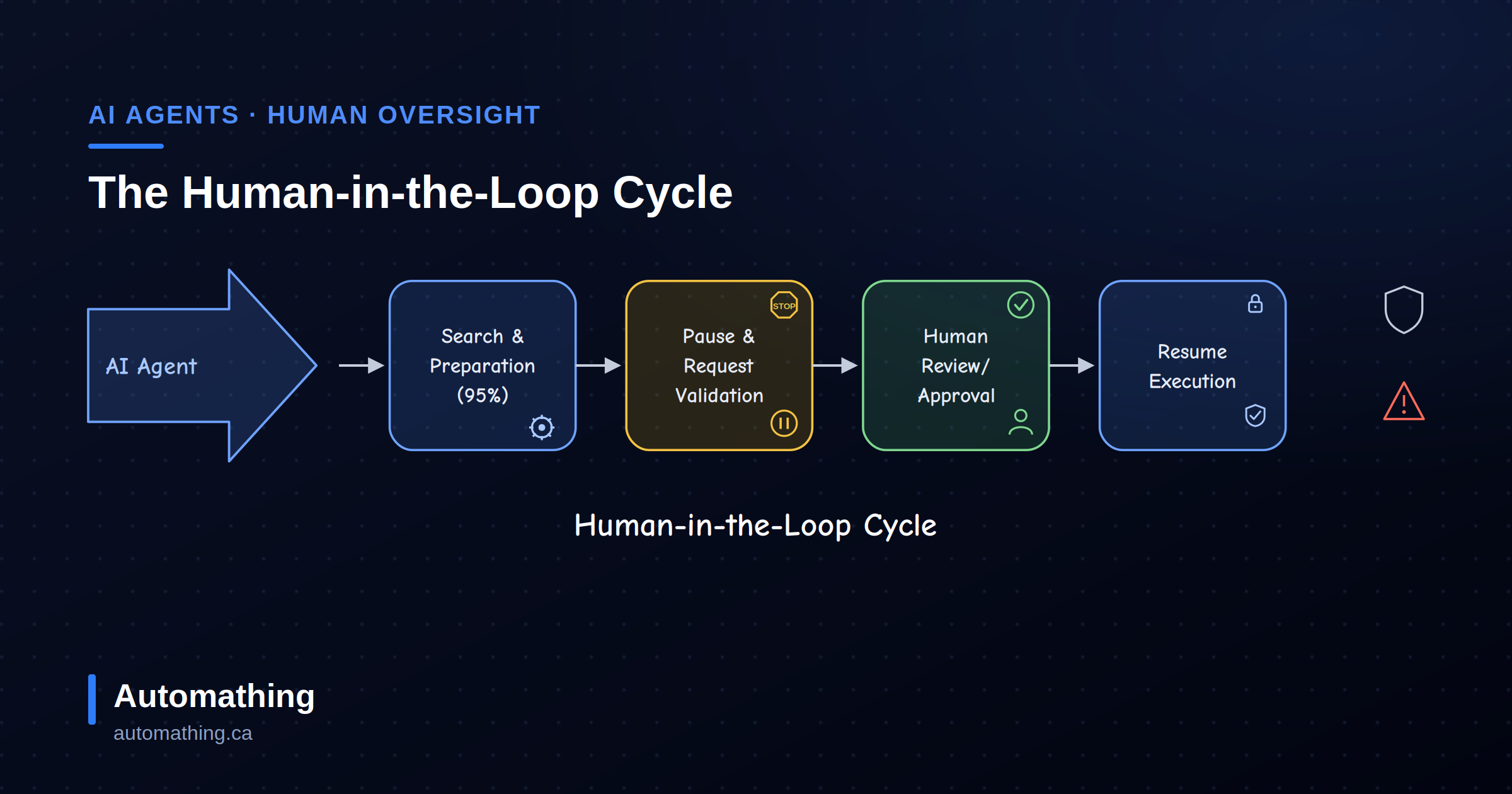
That's why we pair it with a complementary mechanism: human-in-the-loop checkpoints on the actions that are irreversible or publicly visible. Observability covers the 95% of steps where an agent can safely run alone; the checkpoint covers the 5% where seeing the mistake afterward is already too late. Neither replaces the other: one watches the reasoning, the other gates its consequences.
Why AI agent monitoring matters beyond our own case
This isn't a TowerZ-specific problem. As soon as an agent makes autonomous decisions across multiple steps and tools, with some latitude in its reasoning, the same blind spot shows up: the agent can behave correctly on the surface (respond, produce an output, not crash) while having completely drifted underneath.
Without a layer capable of tracing that reasoning, you're not actually running your agents. You're watching them from a distance, after the fact, through whatever symptoms they eventually produce for the user.
Agent observability isn't an optional layer you bolt on once the product has succeeded. It's a condition for being able to claim you actually manage what you've deployed.
Frequently asked questions
What is AI agent observability?
AI agent observability is the practice of tracing an AI agent's reasoning in production: the sequence of tools it calls, its intermediate decisions with their context, and per-phase latency. It answers "did the agent's path make sense?" rather than only "did the service respond?".
Why aren't classic logs and metrics enough for AI agents?
Because an agent's failures don't throw exceptions. It can hallucinate, pick the wrong tool, or loop on a step while every request returns 200 OK. Classic observability monitors infrastructure health; what fails in an agent is the reasoning, which leaves no trace in a standard stack.
What should you monitor in an AI agent in production?
At minimum: the exact tool-call sequence per run, latency per phase, every intermediate decision with its context, drift signals against expected behavior, and the ability to replay a complete run. The unit of observation is the run, not the request.
How do you catch AI agent drift before users do?
By instrumenting the reasoning path and comparing it against expected patterns, so anomalies surface from your own tooling instead of client feedback. For actions that are irreversible or client-facing, add a human approval checkpoint on top: detection after the fact is too late for those.
Go further
This article draws on Automathing's experience building and operating TowerZ's autonomous agents in production. Explore our software development services or book a free discovery call to talk about observing and hardening your own AI agents.