"Do we need RAG for our project?" It's one of the questions that comes up most often as soon as a project touches AI. The honest answer: it depends. Here's how we settle it.
What an LLM doesn't know
An LLM knows a lot of things. But it doesn't know:
- Your internal data
- Your documents that change every week
- Your customers' history
- Your product's documentation
That's where RAG comes in.
RAG: Retrieval-Augmented Generation. The idea fits in one sentence: give the AI the right documents at the right time, before it answers.
Instead of stuffing everything into the prompt and saturating the context, you retrieve only what's relevant to the question being asked. The AI then answers with your knowledge, not just its own.
The real benefits
- Token optimization: you only inject what's useful. Less context means fewer tokens consumed, which means lower costs, especially at scale.
- Response speed: a shorter context gets processed faster. The difference is noticeable the moment you go to production.
- Scalability: your knowledge base can grow indefinitely, the model only ever sees a slice of it at a time.
- Fewer hallucinations: the AI answers from your documents, not from what it thinks it knows.
- Traceability: you know exactly which source was used to generate the answer.
That last point is often underrated. For a client who needs to be able to justify an answer given by an agent, even just for a compliance check, knowing precisely which source fed which answer isn't a luxury.
How RAG actually works
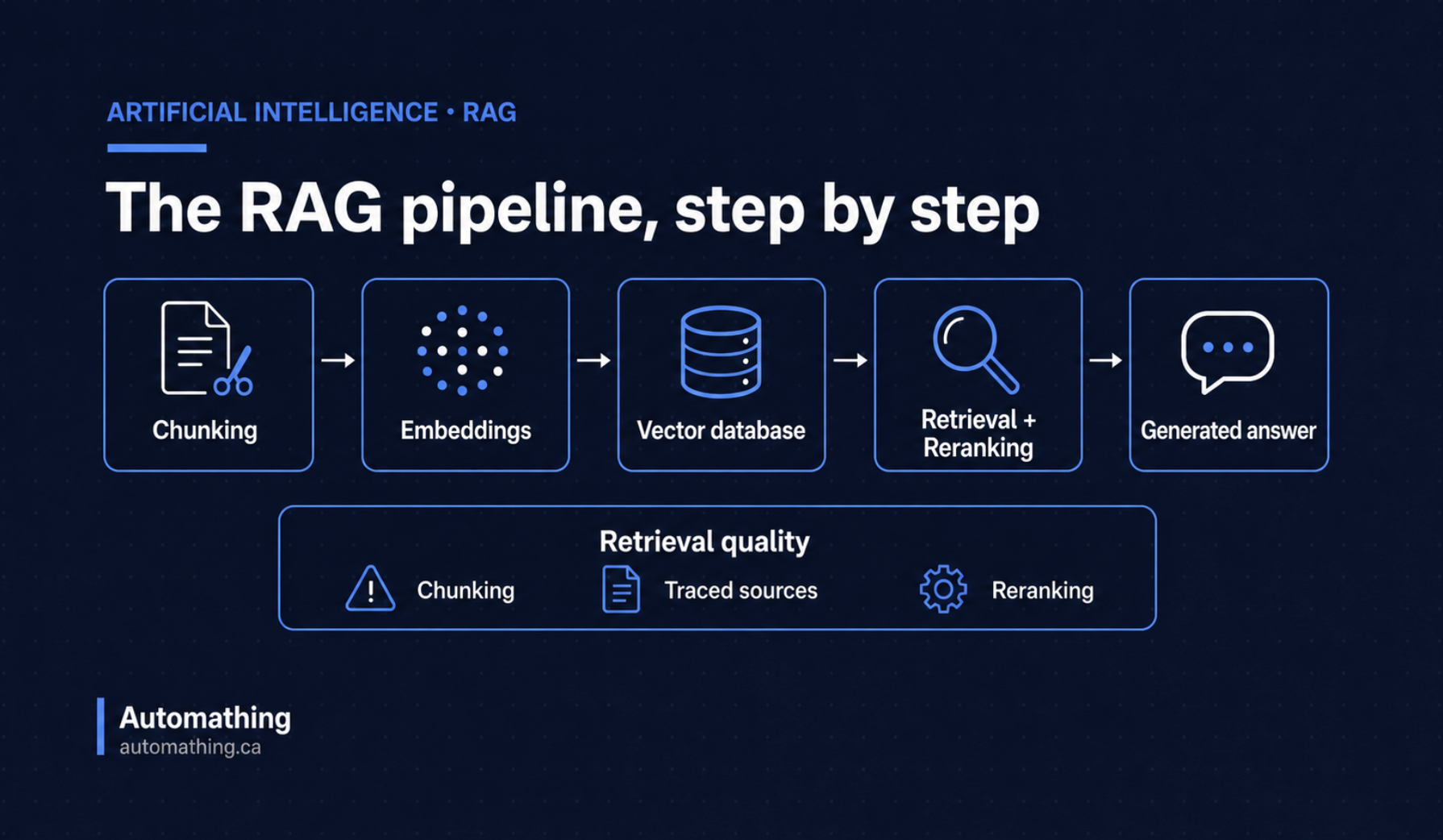
Behind the acronym, the pipeline comes down to five steps:
- Chunking: your documents get split into manageable segments, not too large (noise drowns out the relevant information) and not too small (context disappears).
- Embeddings: each segment is converted into a numeric vector that captures its meaning, not just its keywords.
- Indexing: those vectors get stored in a vector database (Pinecone, Weaviate, pgvector, among others), built to quickly find the segments closest to a given query.
- Retrieval: when a user asks a question, the system searches by similarity for the most relevant segments in that database.
- Augmented generation: the retrieved segments get injected into the prompt sent to the model, which formulates its answer from that context, not from memory alone.
A reranking step often sits between retrieval and generation: a lighter model re-scores the retrieved segments to keep only the most relevant ones, instead of trusting the raw order returned by the vector database. It's an implementation detail that often makes the whole difference between a RAG that works and a RAG that hallucinates anyway.
Each of these steps is a place where quality can leak out. Bad chunking, embeddings poorly suited to your domain, or skipping reranking, and the model gets noise instead of useful context, even if the overall architecture is sound.
When it's useful
- Your data changes often: documentation, internal policies, product catalog.
- You have a large internal knowledge base.
- You want precise, sourced answers that trace back to the original document.
When it's not useful
- Your data is static and small: put it directly in the prompt.
- You don't need traceability on where answers come from.
In these cases, adding a RAG pipeline means building retrieval infrastructure for a problem a well-written prompt already solves. It's free complexity: a vector database to maintain, an indexing pipeline to monitor, extra latency on every request, for a gain that doesn't exist if the context already fits in the prompt.
RAG, fine-tuning, or a long context window?
Three approaches keep coming up when people discuss how to connect an LLM to specific knowledge, and they don't solve the same problem.
- Fine-tuning trains the model on your data so it absorbs a style, a vocabulary, or a domain-specific reasoning pattern. It's a poor fit for factual knowledge that changes: every update to your documents requires a new, slow, expensive training run, while a RAG index updates in minutes.
- Long context windows (models that accept hundreds of thousands of tokens) reduce the temptation to reach for RAG on small corpora, but they don't replace it at scale: the longer the context, the more the model tends to lose precision on information buried in the middle (the lost in the middle effect), and every request costs more and responds slower, even when most of that context has nothing to do with the question being asked.
- RAG remains the only one of the three that selects only the information relevant to the question at hand, with a knowledge base that can grow indefinitely without ever making each individual request heavier.
In practice, these approaches combine more often than they compete: a model fine-tuned on the expected tone and reasoning, fed by RAG for up-to-date facts.
What we see with our clients
When we help a client on an AI project, the RAG question comes up almost systematically, often before we've even assessed whether it actually applies. The reflex is to bolt it onto any AI project that looks remotely serious.
In practice, the right question is never "should we do RAG?" but "what does the AI need to know, and how often does that knowledge change?" Once that question is answered, the decision to add a retrieval layer or not becomes obvious, instead of a reflexive architectural choice. It's the same logic we apply when designing a multi-agent coding architecture: start from the actual need, not the trendy component.
The mistakes that break RAG in production
Most disappointing RAG implementations don't suffer from a bad model, they suffer from one of these mistakes:
- Arbitrary chunking: splitting by a fixed character count, without respecting the document's logical structure, breaks meaning mid-idea.
- Skipping reranking: without this step, the vector database often returns segments that are semantically close but not relevant to the exact question asked.
- Generic embeddings on highly specific domain vocabulary: the embedding model doesn't capture the nuances particular to your field.
- An index that never gets resynced: the vector database reflects documents from six months ago, not today's version.
- Confusing volume with relevance: retrieving more segments doesn't help if half of them have nothing to do with the question; it dilutes the signal instead of strengthening it.
These mistakes share one thing in common: they're invisible as long as you only look at the final answer. That's why the observability layer we run on our agents also traces the retrieval path, not just the generation step: which segments got retrieved, in what order, and whether they actually had anything to do with the question asked.
The real diagnosis when AI hallucinates
RAG isn't a universal solution. It's a precision tool.
If your agent hallucinates in production, the fix isn't always a better model. It's often a better retrieval strategy: better chunks, better reranking, a better search query sent to the vector database. Swapping models without fixing retrieval treats the symptom and leaves the cause untouched.
And for answers where a residual hallucination would carry a real cost, whether that's a commitment made to a client or an irreversible action, a well-built RAG pairs with a human-in-the-loop checkpoint rather than relying on retrieval quality alone.
Frequently asked questions
What is RAG (Retrieval-Augmented Generation)?
RAG is an architecture that retrieves the documents relevant to a question from a knowledge base, then injects them into the prompt sent to the model before it generates an answer. The AI answers from your data this way, not just from what it learned during training.
What's the difference between RAG and fine-tuning?
Fine-tuning trains the model on your data so it absorbs a style or reasoning pattern; it's costly to keep updated. RAG connects the model to an external knowledge base, consulted on every question; a RAG index updates in minutes, not a full new training run. The two are often combined rather than mutually exclusive.
Does RAG completely eliminate hallucinations?
No. It sharply reduces them by grounding answers in real documents, but bad chunking, skipped reranking, or embeddings poorly suited to your domain can still produce wrong answers. Retrieval quality determines answer quality.
Do long context windows make RAG unnecessary?
Not at scale. A long context lets you skip RAG for a small, static corpus, but the model loses precision when relevant information is buried in a massive context, and every request costs more and responds slower. RAG remains the only approach that selects only the information relevant to each specific question.
How long does it take to set up RAG?
It mostly depends on the quality and volume of your source data, not the infrastructure itself: a basic pipeline (chunking, embeddings, vector database, retrieval) can be set up quickly, but most of the real work happens afterward, tuning chunking, reranking, and query strategy for your specific use case.
This article draws on Automathing's experience designing AI agents in production, including for TowerZ. Explore our software development services or book a free discovery call to figure out whether RAG is actually the right answer to your problem.

About Ismael Messa
CTO & Co-Founder, Automathing
Ismael leads the technical vision and architecture of Automathing's platforms. His work spans cloud, systems integration, and scalable SaaS design. He holds a bachelor's degree in software engineering and several industry certifications.
Related articles
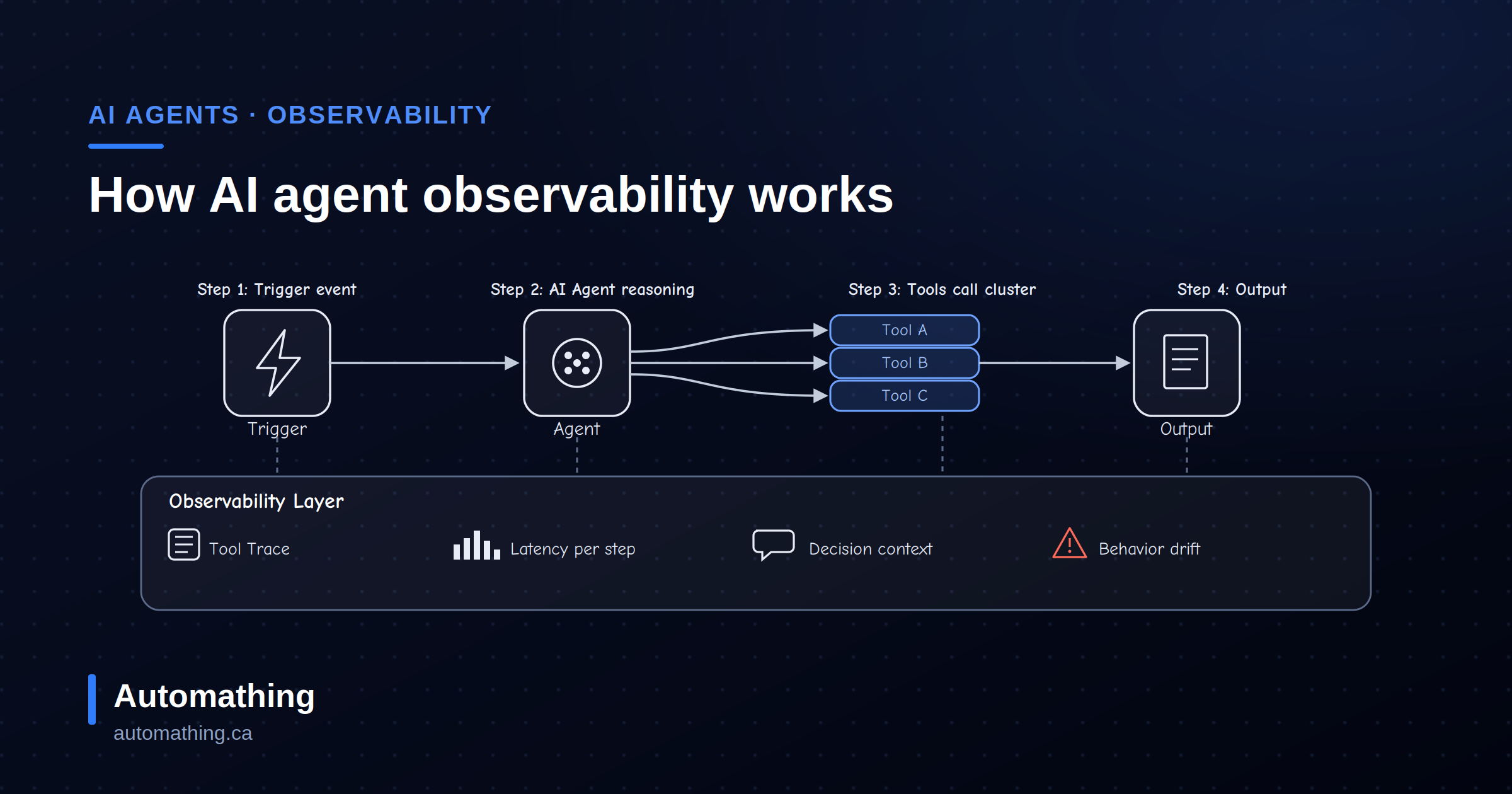
AI Agent Observability: Your Agent Doesn't Crash, It Drifts
An AI agent doesn't crash: it hallucinates, loops, picks the wrong tool, and still returns 200 OK. How we built observability for our agents' reasoning.
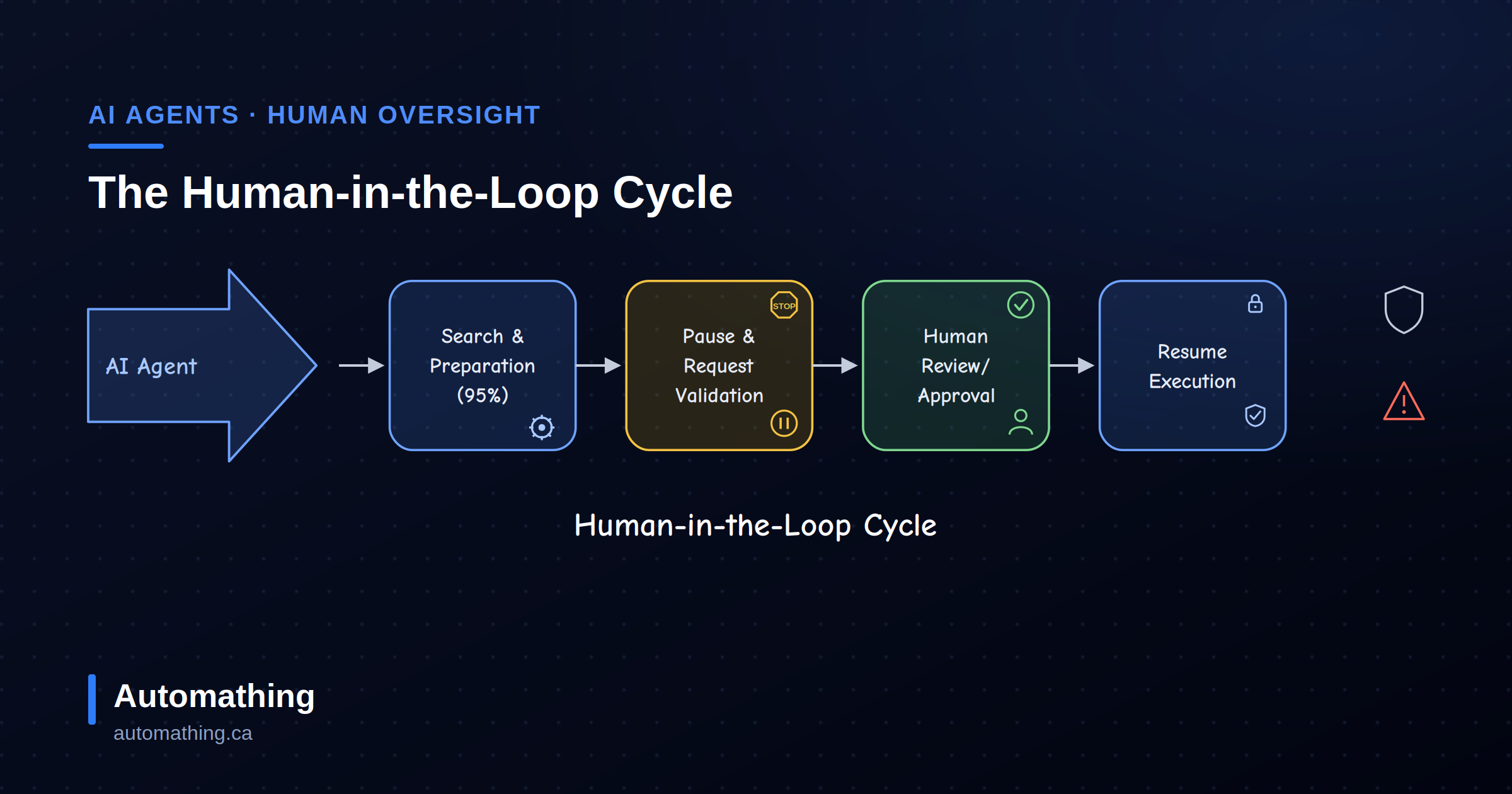
Human-in-the-Loop: The Checkpoint Missing From Your AI Agents
Full autonomy is a risk on critical actions. How to add human-in-the-loop checkpoints to your AI agent workflows, with a real example from TowerZ.
Building an AI Coding Agent Team: What Actually Works
Multi-agent coding architecture at Automathing: one orchestrator per project, specialized AI coding agents, and rules written from real errors.