
Fully autonomous AI agents sound great on paper. In production, it's a different story.
We talk a lot about agents capable of executing complex tasks from A to Z with zero intervention. But in the real world, would you give an AI direct access to your social media accounts, your database, or your marketing budget, with no verification at all? Probably not.
What is Human-in-the-Loop (HITL)?
Human-in-the-Loop (HITL) is an architecture pattern where an AI agent works autonomously, but pauses at predefined checkpoints to request human approval before executing a critical action. The agent does the research, the drafting, and the technical preparation on its own; a human reviews and signs off only where a mistake would be expensive or irreversible.
It's the difference between an agent that can publish anything at any moment, and an agent that prepares the publication, then waits for a green light. Same intelligence, same speed on the 95% that carries no risk, but a deliberate stop on the 5% that does.
The real risk with autonomous AI agents: the missing checkpoint
Full autonomy over critical actions is a risk. Not because the agent reasons poorly, most of the time it does its job well, but because no system, human or AI, should have the final word on an irreversible action without the possibility of a second look.
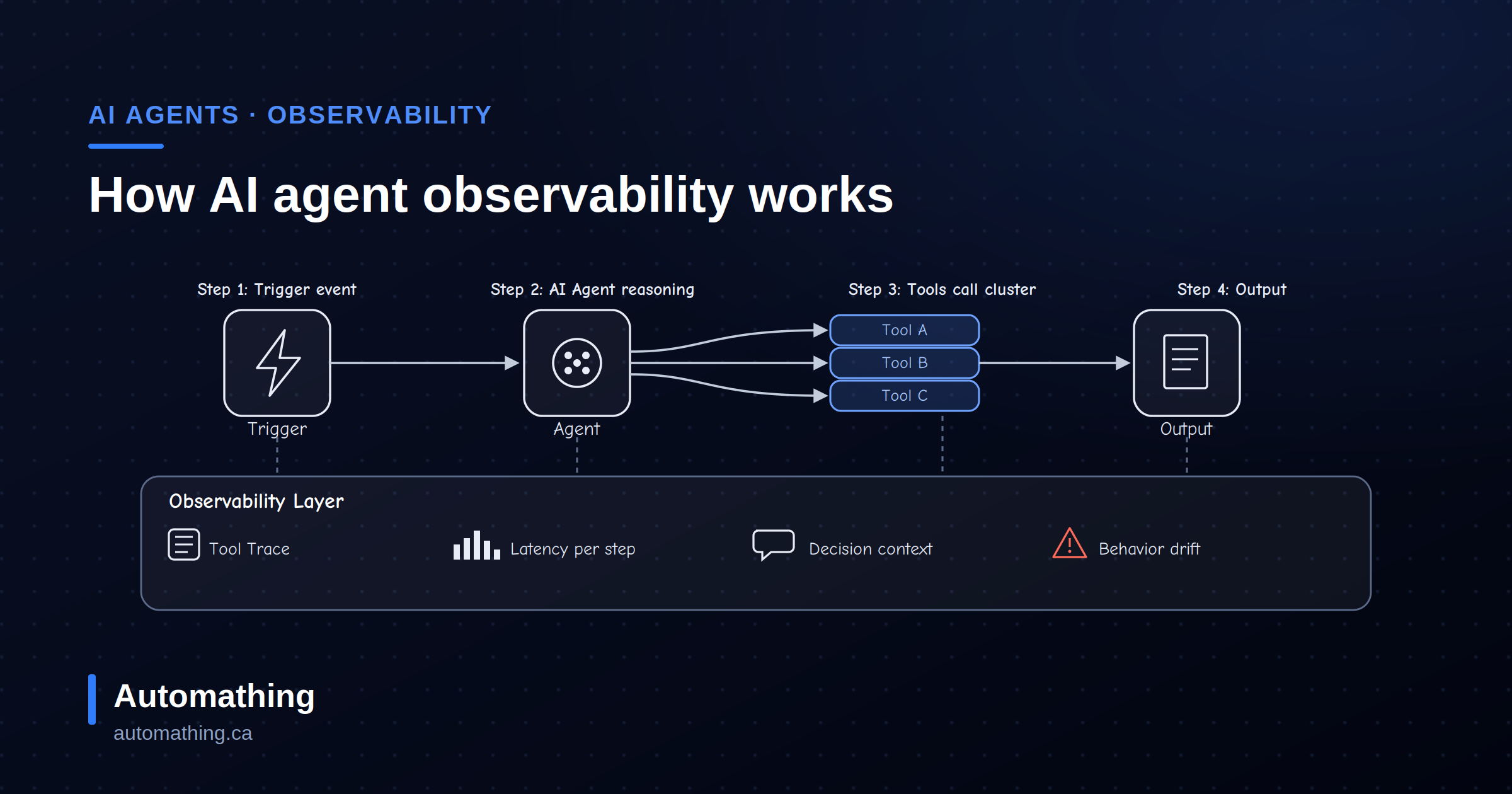
The failure mode isn't dramatic either. An agent rarely goes rogue; it drifts. It misreads an ambiguous instruction, picks a plausible-but-wrong interpretation, and executes with full confidence. We've written about why an AI agent doesn't crash, it drifts, and why classic monitoring won't catch it. Observability tells you what happened. A checkpoint decides whether it's allowed to happen at all.
The solution isn't to rein in the AI by restricting what it's allowed to do. That would cancel out all the velocity it brings in the first place. The solution is to build in the human-in-the-loop principle: teach the agent when it needs to stop and ask for permission, rather than deciding upfront whether it's allowed to reason at all.
How we built human-in-the-loop into TowerZ's agents
This is exactly the approach we settled on while building TowerZ.
Our agents are capable of reasoning, researching, and preparing complex tasks fully autonomously. But we structured the workflows to include checkpoints that can't be crossed without human sign-off, placed precisely where a mistake would be costly: publishing, writing to a database, spending budget.
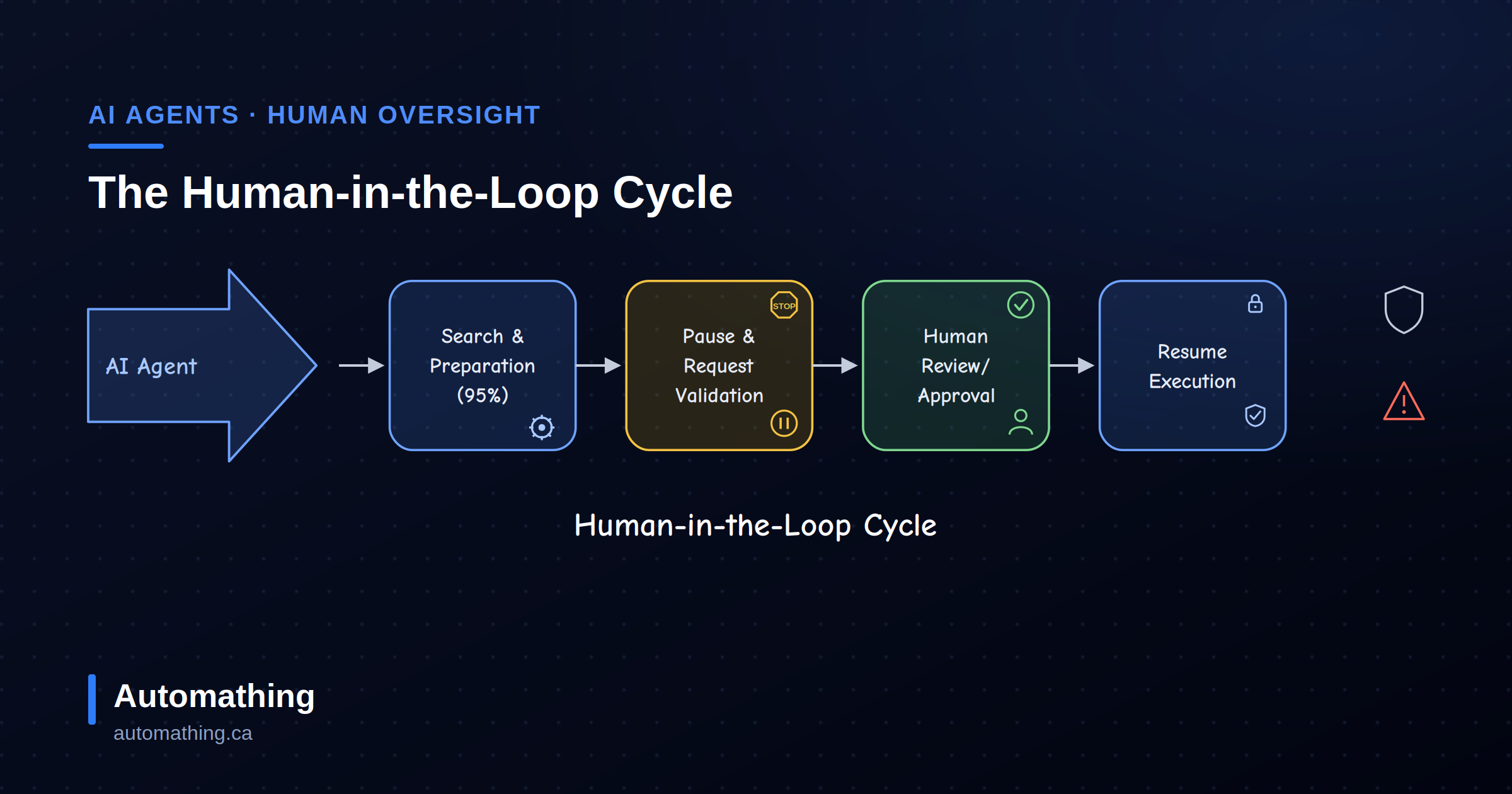
The cycle then becomes:
- The agent does 95% of the work: research, drafting, technical prep.
- The agent pauses execution and requests human interaction.
- The human approves, corrects, or rejects.
- The agent resumes execution safely.
In practice, that pause takes the form of an approval queue. The agent packages everything the human needs to decide in seconds: what it wants to do, why, and what it will execute once approved. A checkpoint that requires ten minutes of investigation per approval is a checkpoint people will start rubber-stamping, and a rubber-stamped checkpoint is worse than none, because it feels like oversight without being any.
The checkpoint isn't an admission of distrust toward the AI. It's an architectural choice: deciding in advance which actions deserve a human look, instead of finding out after the fact, once the action has already been executed.
What human oversight actually changes
We combine the AI's blazing velocity with the human's judgment, empathy, and safety net. The agent is no longer an unpredictable tool you watch out of the corner of your eye, hoping it won't do anything drastic. It becomes a proactive collaborator that knows when to loop in its manager, much like a competent junior employee who's still learning which decisions carry real stakes.
There's a second-order effect too: trust compounds. Once a team knows the agent physically cannot publish, spend, or delete without sign-off, they stop supervising everything else it does. Paradoxically, adding a few hard checkpoints is what lets you remove the constant informal babysitting. The agents on TowerZ got more autonomy over time, not less, because the boundaries were explicit.
This ties back to a principle we apply everywhere in how we build AI coding agent teams: the more reversible and low-stakes a task is, the more an agent can run on its own. The more costly an action is to undo, the more non-negotiable the human checkpoint becomes.
Where to place human-in-the-loop checkpoints
HITL only has value if the checkpoints sit in the right place. Too few, and the original risk stays fully intact: the agent keeps control over critical actions without real oversight. Too many, and the agent has to stop at every step to ask for approval, which cancels out the speed gain you were after with AI in the first place.
The criteria we use to decide where to place a checkpoint:
- Reversibility: an action that's easy to undo tolerates more autonomy than a permanent one. A draft can be regenerated; a sent email cannot be unsent.
- External visibility: anything reaching a client, an end user, or a public audience deserves a human look before it goes out.
- Cost of error: a budget spend or a critical database write doesn't get to be trial and error.
Score an action low on all three, and the agent runs free. Score it high on any one, and it earns a checkpoint. It's the same reasoning we recommend when deciding what to automate first: start where errors are cheap, and expand autonomy as confidence builds.
Frequently asked questions
What does human-in-the-loop mean for AI agents?
Human-in-the-loop (HITL) means an AI agent executes tasks autonomously but must obtain human approval at specific checkpoints before performing critical actions, such as publishing content, writing to a database, or spending money. The human validates, corrects, or rejects; the agent then resumes.
Doesn't a human checkpoint defeat the purpose of automating with AI?
No, if the checkpoints are placed correctly. The agent still does the vast majority of the work autonomously: research, drafting, preparation. The human intervenes only on the small fraction of actions that are irreversible or costly. You keep almost all the speed while removing almost all the risk.
Which AI agent actions should always require human approval?
Any action that scores high on at least one of three criteria: it's hard to reverse, it's visible to clients or the public, or the cost of getting it wrong is significant. Typical examples are publishing to external channels, critical database writes, and budget spends.
How is HITL different from reviewing the AI's output afterward?
An after-the-fact review catches mistakes once they've already happened, when the email is sent or the budget is spent. A human-in-the-loop checkpoint blocks the action before execution, at the exact points you decided in advance were too costly for trial and error.
Go further
So, on which tasks do you insist on keeping final control before letting AI hit the button?
This article draws on Automathing's experience building TowerZ's autonomous agents. Explore our software development services or book a free discovery call to talk about structuring your own AI agent workflows.