
The most commonly cited AI failure mode is not a hallucination, a broken API, or a slow model. It is an organization that launched a project before asking the right questions. The technology worked fine. The business case was missing.
This pattern repeats across industries and company sizes. Teams invest in AI, something runs in production, and six months later nobody can name a concrete outcome. According to a widely cited 2025 MIT study, roughly 95% of enterprise generative AI projects produce no measurable return. That number is inconvenient, so most executive teams choose not to sit with it.
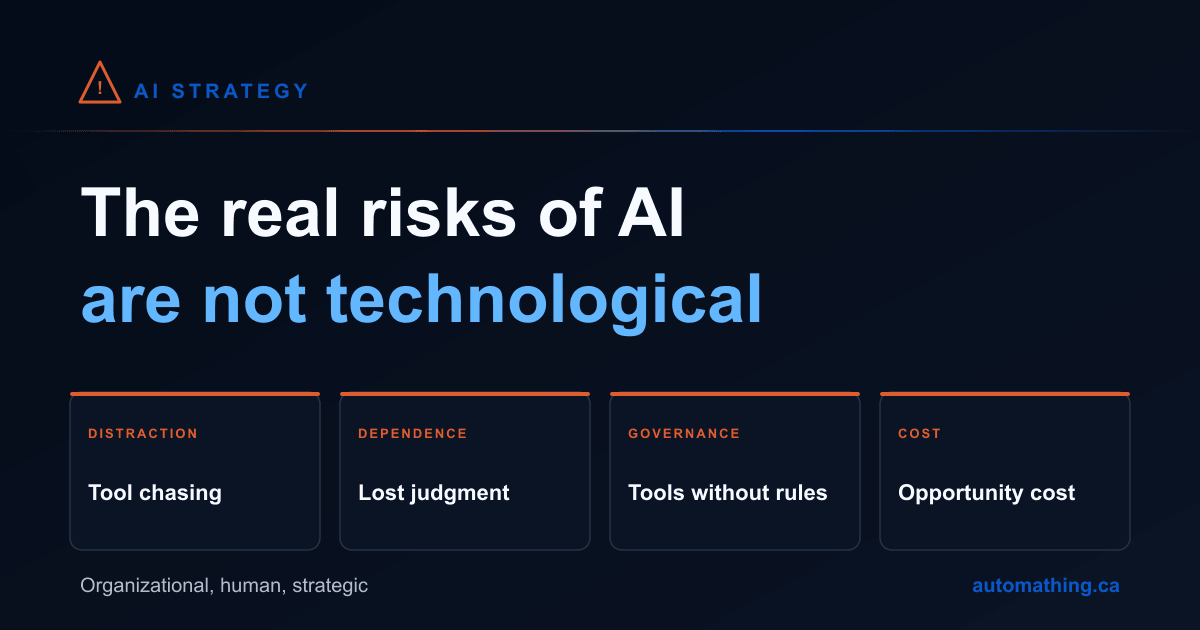
The reason most AI projects fall short has nothing to do with the model. It has everything to do with the eight non-technological risks that get glossed over in the race to deploy. Understanding them is the first step toward using AI as an actual growth lever rather than an expensive experiment.
The core idea: A company can succeed technically at every stage of an AI project and still fail completely to create value. That failure lives in the strategy, the organization, and the people, not in the model.
1. The distraction trap: chasing tools instead of solving problems
Every week brings a new model, a new agent framework, a new benchmark. Leaders feel pressure to stay current, and "staying current" often gets confused with "doing something useful." The result is a perpetual evaluation cycle. Teams spend more time reading product release notes than fixing the processes those tools were supposed to accelerate.
The distraction is not neutral. Every sprint dedicated to evaluating yet another copilot is a sprint not spent on understanding what customers actually want, what operations actually cost, or what decisions actually stall the business. Novelty has a real opportunity cost.
The useful question is not "what is the latest tool?" but "what is the most expensive problem we are not solving today?" Answering the second question forces an honest conversation that most tool evaluations never reach.
2. Investing before defining the business problem
"We need to do AI" is a budget justification masquerading as a strategy. It tells you nothing about which process will change, by how much, for whom, or by when. Without a clearly defined business problem, any AI project becomes a solution looking for a question.
The failure mode here is subtle. A team can build something technically impressive, demo it flawlessly, and never answer the real question: does this change a number that matters to the business? When the answer is no, the project gets called a success in the post-mortem and quietly shelved six months later.
Before any project starts, the leader sponsoring it should be able to name the specific inefficiency being addressed, the measurable outcome expected, and the owner accountable for that outcome. If any of those three is missing, the project is not ready. Our 4-question framework for AI projects gives a fast way to run that check. Once the problem is defined, our 3-factor scoring framework ranks it against everything else competing for the same budget.
AI in Business: 4 Questions to Ask Before Any AI Project
Before launching any AI project, answer these 4 strategic questions: inefficiencies, team alignment, target outcomes, and data governance.
3. Losing internal skills through excessive dependence
There is a version of AI adoption where the organization gets faster at producing outputs and slower at understanding them. Writers use AI for every first draft and stop developing their own voice. Analysts use AI to summarize data and stop building the intuition that catches bad summaries. Developers use AI to write code and stop learning why one approach is safer than another.
Excessive dependence does not feel like a risk while it is happening. It feels like productivity. The cost shows up later, when an AI tool produces a confident wrong answer and nobody on the team has the depth to catch it. Or when the vendor changes pricing and the organization realizes it no longer has the internal capacity to do the work any other way.
The mitigation is deliberate: use AI to amplify existing skills, not to replace the practice of building them. Juniority in a skill has to be earned before automation of that skill is safe.
4. Decisions made on unverified AI outputs
Generative AI produces fluent, confident, plausible text. Those properties have nothing to do with accuracy. A model that states a statistic, cites a source, or summarizes a contract with full confidence can be wrong. Fluency is not a signal of correctness.
The risk compounds in organizations where the output gets copied into a slide deck, presented to leadership, and used to make a decision, without a single person verifying the source. This is not a hypothetical. It happens regularly, and the damage ranges from mildly embarrassing (a wrong market size figure in a pitch) to legally significant (a misread contract clause).
The organizational safeguard is simple: establish a verification norm. AI output is a starting point, not a finished product. Any number, claim, or recommendation that will influence a real decision needs a human source check before it goes upstream. This applies regardless of how plausible the output sounds.
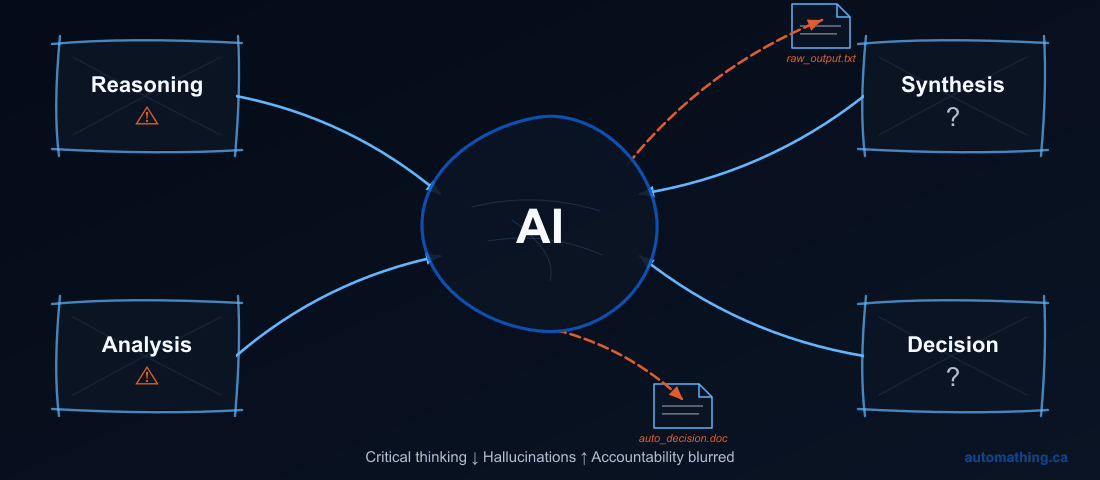
5. The slow erosion of critical thinking
The distraction trap costs time. The dependence trap costs skills. The critical thinking erosion is more insidious: it costs judgment. When an AI tool provides an answer quickly, the cognitive path of working through the problem yourself gets bypassed. Over many repetitions, the habit of asking "is this right, and why?" atrophies.
Organizations that over-delegate thinking to AI models end up with teams that are better at prompting than at reasoning. They can get to an answer faster but they are less equipped to question whether the answer is good. In complex, ambiguous situations, that is exactly the moment when judgment matters most.
Preserving critical thinking is not about refusing AI tools. It is about using them in a way that keeps the reasoning process visible. Have the team explain the AI output in their own words before acting on it. Use AI as a sparring partner, not a decision-maker. The goal is augmented thinking, not outsourced thinking.
6. Employee resistance and the absent change management plan
Technology projects fail at deployment far more often than at development. A system that works flawlessly in a test environment and gets rejected by the people who were supposed to use it is a failed project, regardless of what the code does.
Resistance is almost never irrational. Employees resist AI tools when they do not understand what the tool does to their job, when they were not involved in selecting it, when nobody has addressed their legitimate concerns about job security or accountability, or when the training they received lasted forty minutes and covered none of the real edge cases.
Change management is not a soft add-on. For any AI project that touches daily workflows, it is a core deliverable. That means mapping who is affected, communicating early, involving end users in the design, and building in time for real adoption rather than forced compliance. Projects that skip this step consistently underperform projects that take it seriously.
7. Tool proliferation without governance
A company with fourteen AI tools, no shared data standards, no access policy, no audit trail, and no owner accountable for each system does not have an AI strategy. It has accumulated technical debt dressed up as innovation.
Tool proliferation happens because the barrier to entry for AI tools is low and the pressure to adopt is high. Each team adopts a tool to solve a local problem. Nobody steps back to ask whether the same need is already covered by something else in the stack, whether the data shared with this vendor is covered by your privacy policy, or whether anyone will know what happened if an automated output causes a problem.
Governance does not mean slowing everything down. It means having a clear owner for each tool, a list of approved vendors, a data classification policy, and a standard for documenting what each automation does and why. That infrastructure takes a few weeks to set up and prevents months of cleanup later. Quebec's Law 25 adds a legal dimension: any AI system that touches personal data needs a documented accountability chain.
8. The opportunity cost of experimenting instead of executing
Not all experimentation is waste. Pilots are how organizations learn what works. But there is a version of piloting that never ends, where teams rotate through proofs of concept without ever committing to a production deployment that changes a real metric.
This pattern has a cost that rarely appears in a budget line. Every engineer running a sixth POC is not building the product feature that customers asked for. Every operations manager testing another workflow automation tool is not improving the process that already runs. Experimentation crowds out execution, and execution is where business value actually accumulates.
The discipline required is a clear threshold for moving from pilot to production. What outcome would make this pilot a success? When would we expect to see it? If we hit it, what happens next? Those questions, answered before the pilot starts, are what separates structured experimentation from indefinite tinkering.
The rule of thumb: If a pilot cannot be described in one sentence, named a clear success condition, and assigned a go/no-go date, it is not a pilot. It is a distraction with a budget.
Putting the eight risks together
These risks do not arrive separately. They compound. An organization chasing tools (risk 1) is likely adopting them without a business case (risk 2), accumulating them without governance (risk 7), and spending so much time evaluating that it never executes (risk 8). The team along the way grows dependent (risk 3), stops verifying outputs (risk 4), loses critical thinking (risk 5), and never brought employees along for the ride (risk 6).
The common thread is organizational discipline: the willingness to be structured before being fast, to be clear before being impressive, and to measure before claiming success. That discipline is not a constraint on AI adoption. It is the precondition for AI adoption that actually works.
This is the core of what we mean by Business + Technology, without unnecessary complexity. The goal is not to slow down your AI ambitions. It is to make sure those ambitions land on a foundation solid enough to hold them.
Frequently asked questions
Does this mean we should slow down our AI adoption?
No. It means you should be deliberate rather than reactive. Speed matters in competitive markets, but undirected speed is not a strategy. The organizations creating the most value from AI right now are not the ones that deployed the most tools. They are the ones that defined a clear problem, ran a disciplined pilot, measured the outcome, and scaled what worked.
How do we know if we have a real business case for an AI project?
You can state the specific process being improved, the measurable outcome expected, and the owner accountable for that outcome, all in under three sentences. If you cannot do that, the business case is not ready. Our APO Diagnostic is designed to surface exactly that kind of operational clarity.
What does genuine change management look like for an AI project?
It starts before the tool is selected. It means mapping who is affected, involving them in the design, communicating what will change and what will not, and building real training rather than a checkbox session. For most SMEs, this is a two to four week process, not a two-day one.
How do we prevent excessive AI dependence from eroding our team's skills?
Use AI to accelerate skill application, not to skip skill development. A junior analyst who uses AI to format a report still needs to understand the data. A developer who uses AI to suggest code still needs to review it and understand it. The discipline is: AI handles the routine, humans own the judgment. That boundary is not automatic. It has to be set deliberately and enforced by managers.
Is tool proliferation really that dangerous if each tool solves a real problem?
Yes, because the total system cost is not visible at the tool level. Each tool might solve its local problem while adding to a larger fragmentation: inconsistent data, overlapping capabilities, unclear accountability, and compounding vendor exposure. Governance is not about rejecting useful tools. It is about knowing what you have, who owns it, and what data it touches.
What is the difference between healthy experimentation and burning opportunity cost?
A healthy pilot has a clear hypothesis, a defined time limit, a success condition, and a decision gate. If those four elements are not present before the pilot starts, it is likely to drift indefinitely. The check is simple: could you describe this pilot to your board in two sentences and tell them exactly when you will have a decision?
From risk audit to concrete action
At Automathing, every engagement starts with an honest read of the organization before we recommend any technology. Our APO Diagnostic gives leadership a fast, structured view of where the business actually stands, across analysis, planning, and operations, so they know what they are building on before adding AI on top of it. Book a free discovery call and we will identify the most useful first step together.