
Every software agency now says it "does AI." Most of the time, that means one of three things: a chatbot, a flashy proof of concept, or a workflow that works beautifully in a demo and breaks as soon as it touches real operations.
Applied AI is something else.
What is applied AI?
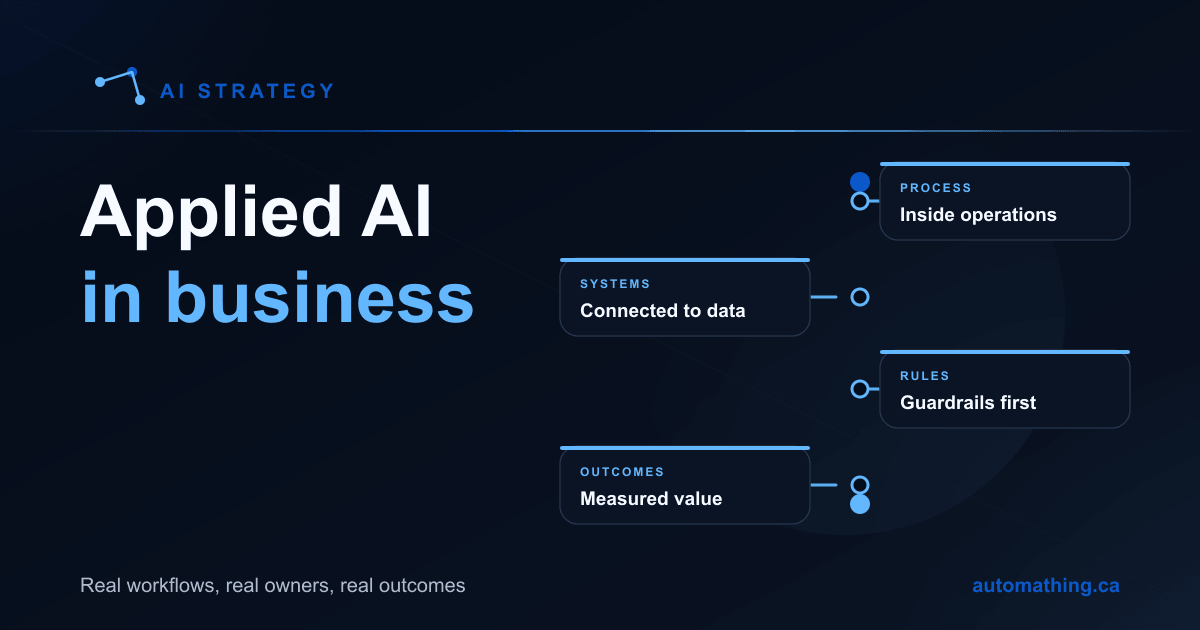
Applied AI is not the model by itself. It is the model inside a real business workflow, connected to the right systems, constrained by the right rules, observed in production, and measured against a concrete business outcome. That is what turns AI from a novelty into operating leverage.
If you want the shortest possible definition, it is this:
Applied AI is AI tied to a real process, a real owner, and a real outcome.
That sounds obvious. It is not how most AI projects are sold.
One way to make the distinction clearer is to separate the work that creates technical capability from the work that makes it useful. AI research creates new possibilities. AI engineering makes them dependable. Applied AI connects those systems to a real workflow. The only meaningful finish line is the business result: more capacity, better quality, lower cost, faster decisions, or less risk.
From capability to outcome
AI Research
Creates new capabilities.
AI Engineering
Makes them reliable systems.
Applied AI
Puts them to work in real workflows.
Business Outcome
Revenue, cost, time, quality, and risk.
The difference between AI as a demo and AI as applied work
A demo answers one question: can the model do something impressive?
Applied AI answers harder questions:
- What system gives the model the data it needs?
- What happens when the answer is uncertain?
- What is allowed to run automatically, and what must stop for human confirmation?
- What if the workflow crashes halfway through?
- How do you know what the AI did, why it did it, and what it cost?
That is the real dividing line.
An AI system that writes a perfect answer in a sandbox but cannot survive ambiguity, outages, retries, approvals, or messy source data is not applied AI. It is a prototype waiting to disappoint someone in production.
What applied AI usually looks like in a business
Applied AI tends to show up in four recurring forms.
1. AI that reads and structures messy information
This is one of the strongest early use cases because businesses are full of unstructured inputs: emails, PDFs, meeting notes, support requests, invoices, contracts, forms.
The model's job is not to "be intelligent" in the abstract. Its job is to classify, extract, summarize, normalize, and route. That is what makes AI useful in workflows like:
- order entry from PDF purchase orders
- support inbox triage
- invoice and receipt extraction
- contract or policy summarization
- note-to-CRM follow-up drafting
In many businesses, this category is the fastest path to value because it removes repeated manual reading and re-entry work without asking the model to make high-stakes autonomous decisions.
2. AI that helps prioritize and recommend
Some of the best applied AI does not act first. It sorts attention.
Which lead is most likely to convert? Which support ticket deserves escalation first? Which client looks at risk? Which anomaly in the data is worth a human review?
This kind of applied AI is powerful because the business does not need perfect autonomy to benefit. Better prioritization alone can improve revenue speed, customer response times, and team focus.
3. AI inside a workflow with human checkpoints
This is where many serious AI systems should live.
The model can draft, classify, compare, enrich, and recommend, but the workflow keeps a human at the points where judgment, risk, or brand responsibility matter. That is the core logic behind human-in-the-loop AI agents: the AI does the heavy lifting, the human keeps the final say where it counts.
Examples:
- an AI drafts a customer response, but a human approves before it is sent
- an AI flags revenue risk, but a manager confirms whether to escalate it
- an AI prepares a strategy revision, but leadership validates the change before it becomes active
This is often a better real-world design than either extreme. Full manual work is too slow. Full autonomy is too risky. Applied AI usually lives in the middle.
4. AI that works continuously in the background
This is where applied AI starts to feel less like a tool and more like infrastructure.
Instead of waiting for a person to ask a question, the system monitors live signals, watches for thresholds, prepares briefs, surfaces exceptions, and proposes next actions. It becomes part of how the business notices what is changing.
That can look like:
- a finance agent watching cancellations, overdue invoices, and cash-flow risk
- a marketing agent reviewing content performance and drafting the next week's plan
- a strategy workflow surfacing KPI drift before the quarter is already lost
This pattern is more advanced, but it is often where the highest leverage appears, because it changes not just execution speed but management visibility.
The five traits that separate real applied AI from AI theatre
There are five signals that usually tell you whether a vendor is building applied AI or just packaging demos.
1. The problem is specific
"We help companies use AI" is not a useful promise.
"We automate support triage for teams receiving 300 repetitive requests a day" is.
Applied AI starts from a narrow operational problem, not a general fascination with the technology. That is the same discipline behind our article on the 4 questions to ask before any AI project: the structure matters more than the slogan.
AI in Business: 4 Questions to Ask Before Any AI Project
Before launching any AI project, answer these 4 strategic questions: inefficiencies, team alignment, target outcomes, and data governance.
2. The AI is connected to the workflow, not bolted on top
If a model produces outputs but nothing in the surrounding system knows what to do with them, the result is friction, not leverage.
Applied AI is connected to the systems where the work already lives: CRM, ERP, support, billing, internal tools, dashboards, knowledge bases. This is why applied AI and systems integration so often travel together.
3. The autonomy level is explicit
One of the biggest mistakes in AI projects is treating autonomy like a binary choice: either the AI does nothing without a human, or it does everything automatically.
Real applied AI uses a spectrum:
- read and analyze automatically
- propose actions for review
- wait for confirmation on risky steps
- keep some actions permanently manual
That is how trust is built safely over time.
4. The constraints live outside the prompt
Telling a model "do not send duplicate alerts" is not enough.
Applied AI puts critical constraints in the system itself: permission layers, cooldowns, schema validation, required approvals, duplicate protection, retry boundaries, audit trails. Anything that absolutely must not happen should be blocked by code or tooling, not left to model behavior alone.
5. The result is measured in business terms
If the only success metric is "the AI works," the project is not finished enough.
Applied AI should be measured the same way you would judge any operational investment:
- time recovered
- errors avoided
- response time improved
- revenue unlocked
- throughput increased
- risk reduced
That is why the strongest applied AI projects often look boring from the outside. They are not optimized for applause. They are optimized for measurable effect.
Where applied AI creates the most value first
The best first applied AI projects usually share four traits:
- the workflow is frequent
- the inputs are already digital
- the manual handling is repetitive
- the error cost or delay cost is visible
In practice, this often means starting with:
- email and inbox classification
- document extraction and routing
- support triage
- proposal drafting support
- anomaly detection and risk flags
- internal knowledge search with supervised answers
These are better starting points than vague ambitions like "build us an AI assistant for everything."
If your team is trying to choose among several candidates, the same logic from how to choose what to automate first applies here too: start where volume, friction, and business stakes are clearest.
What applied AI is not
It helps to be honest about what does not qualify as applied AI, even if it gets marketed that way.
Applied AI is not:
- a one-off chatbot with no integration into the real workflow
- a proof of concept with no owner accountable for the outcome
- a demo that cannot survive approvals, outages, or ambiguous inputs
- a model making irreversible decisions with no review path
- an AI project with no baseline metric and no post-launch measurement
None of those are useless. They can be stepping stones. But they are not the same thing as production-grade applied AI.
The risks when companies adopt applied AI badly
Most applied AI failures do not happen because the model is too weak. They happen because the operating design around it is poor.
Common failure modes:
- unclear ownership of the workflow
- bad or inconsistent input data
- no distinction between low-risk and high-risk actions
- no audit trail
- no fallback path when the AI is uncertain
- no measurement after launch
That is why our own rule of thumb is simple: if the workflow matters enough to automate, it matters enough to govern.
How to adopt applied AI without creating operational risk
The cleanest path is usually:
- Pick one narrow, costly workflow.
- Define the before-and-after metric.
- Decide where the human checkpoints belong.
- Connect the model to the systems that already hold the work.
- Launch with observability, not just prompts.
- Move actions up the trust ladder only after the system earns it.
This is also where AI observability in production becomes important. If you cannot answer what the AI did, why it did it, and what it cost, you do not yet control the system well enough to scale it.
Applied AI is really about business design
The temptation is to think applied AI is primarily a model problem.
It is not.
It is a business-design problem with model components inside it. The hard part is deciding what should be automated, what should be supervised, what should be remembered, what should be blocked, and what success actually looks like.
That is why two companies can use the same underlying model and get radically different outcomes. One gets a toy. The other gets operating leverage.
Frequently asked questions
Is applied AI just using ChatGPT at work?
No. Using a chatbot is an individual productivity habit; applied AI is a system change. In applied AI, the model is connected to your data and tools, runs inside a defined process with rules and approvals, is monitored in production, and is judged on a business metric rather than on how impressive the output feels.
What is the difference between applied AI and generative AI?
Generative AI refers to the model capability itself: generating text, summaries, images, or code. Applied AI is the practical business implementation of those capabilities inside a workflow that has owners, rules, integrations, and measurable goals.
What are examples of applied AI?
Examples include support-ticket triage, invoice extraction, lead prioritization, internal knowledge assistants, risk alerts, forecasting support, and supervised AI drafting inside customer or operations workflows.
Is applied AI only for large companies?
No. In fact, some of the best applied AI use cases are in SMBs because the workflows are specific, the gains are measurable, and the teams feel the operational friction immediately.
How do we know if a workflow is a good candidate for applied AI?
It is usually a good candidate when it is frequent, repetitive, digital, and expensive in time, delay, or error cost. If the workflow is vague, low-volume, or mostly judgment with no usable data, AI is often the wrong first move.
From AI curiosity to applied AI that works
Applied AI is not about adding intelligence for the sake of it. It is about designing systems where AI does useful work, inside useful constraints, for useful outcomes.
That is the standard we use in our artificial intelligence and machine learning work: real workflows, real controls, real leverage. Book a free discovery call and we will help you determine whether your next AI idea is a real applied-AI opportunity or just another demo waiting to fail.